
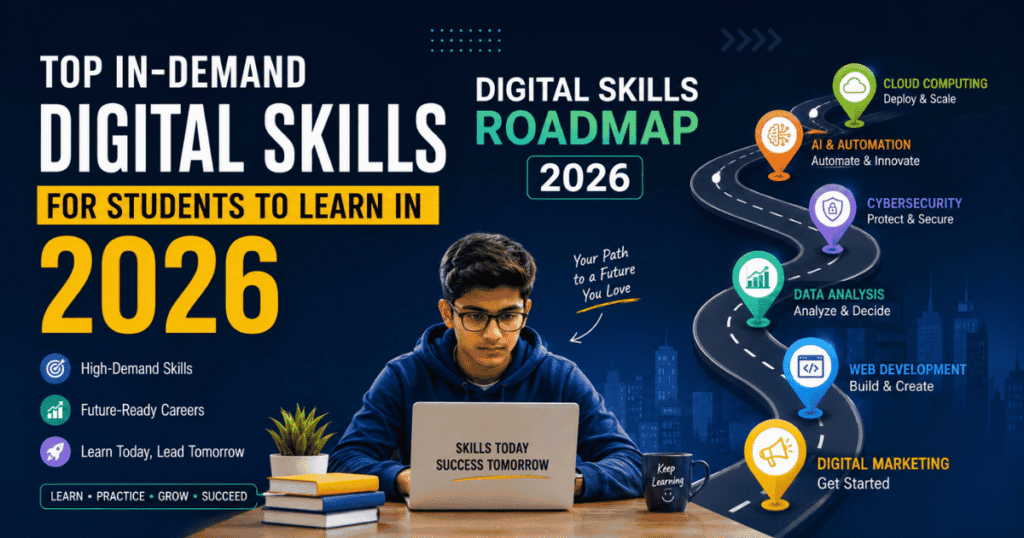
Which digital skills should you learn in 2026? Compare real options, free ways to start, and honest data on what actually gets students hired today.
Every list online names the same five skills: AI, data, coding, marketing, cybersecurity. That part is not wrong. What most lists skip is timing. Not every skill on that list is worth your attention right now, in the same way, at the same pace. Some are worth starting today.
Some are worth building toward. A few are only worth watching for now. Very few students are ever told the difference.
This guide sorts them that way, on purpose.
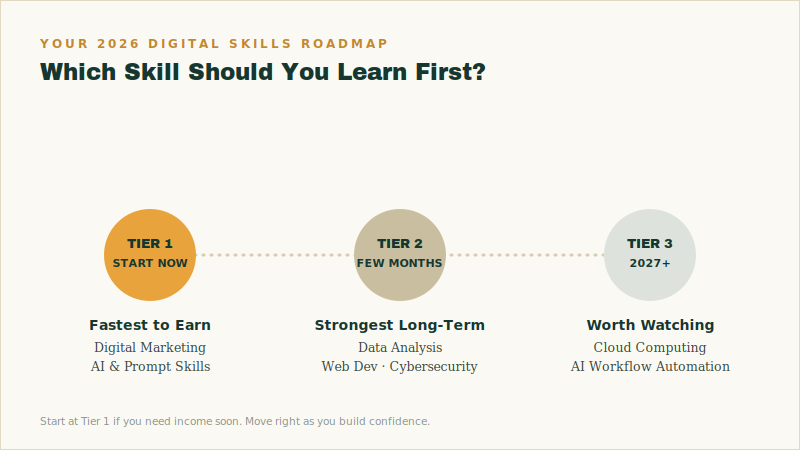
- TIER 1: Skills That Get You Paid the Fastest
- TIER 2: Skills With the Strongest Long-Term Demand
- TIER 3: Skills Worth Watching for 2027 and Beyond
- Which Skill Fits How You Actually Think
- Common Mistakes Students Make When Choosing a Skill
- One Program's Real Track Record
- A Simple Way to Choose Your First Skill
- Frequently Asked Questions
- Where This Data Comes From
- Final Thoughts: Choose One Skill and Build Something Real
TIER 1: Skills That Get You Paid the Fastest
Some skills convert into real income within weeks, not years, because the barrier to a first paying gig is genuinely low.
Digital Marketing and SEO.
Small businesses live or die by whether people can find them online. Your job would be helping with that: writing posts that get real engagement, running small ad campaigns, nudging a website higher up in Google search results. Pick one real account, even a friend’s shop or a small project of your own, and track what actually moves the numbers. That tracked result becomes your proof.
AI and Prompt Skills.
Nobody is asking beginners to build AI tools. What pays right now is knowing how to use ChatGPT, Claude, or Gemini well: writing prompts that actually get useful answers, catching it when the AI gets something wrong, using it to speed up research or writing instead of replacing your judgment. Most people feel genuinely useful at this within a few weeks of daily practice.
If you need income sooner rather than later, start in this tier. Both of these can be practiced on a phone, and most learning platforms let you audit the core lessons for free.
TIER 2: Skills With the Strongest Long-Term Demand
Other skills take longer to feel confident in, but the demand behind them runs deeper and stays more stable over time.
Data Analysis.
Somebody has to turn a messy spreadsheet into a decision someone can act on. That is the job, in a sentence. Excel and Google Sheets are the real starting point, not SQL or Python, no matter what other guides tell you.
Retail, healthcare, education, almost every industry needs someone who can spot a pattern in the numbers and explain what it means
Basic Web Development.
A portfolio page. A basic online store. All of these come from the same starting toolkit: HTML, CSS, and a bit of JavaScript. It takes a few months before it feels solid, but once it does, nothing proves the skill faster than sending someone a working link,
Cybersecurity Basics.
Data gets stolen more often than most people realize, usually through simple mistakes: a weak password, one wrong click, a system
nobody bothered to secure properly. Learning to prevent that is the core of this skill. It is growing fast, though most entry-level roles still want to see a certificate or some foundational coursework first.
If you can invest a few months before expecting results, this tier tends to pay off more over the long run.
TIER 3: Skills Worth Watching for 2027 and Beyond
A couple of skills are not fully mainstream yet, but the direction is clear enough to start early if you are genuinely curious.
Cloud Computing Basics.
Most businesses no longer run their software on physical servers sitting in an office. They rent space on platforms like AWS, Google Cloud, or Microsoft Azure instead. This is rarely anyone’s first skill, but once you are already working in data or web development, it starts showing up as an expectation, not a bonus
AI Workflow Automation.
Imagine a system that reads an incoming message, drafts a reply, and schedules a follow-up, all without a person doing any of those steps by hand. That is workflow automation, usually built with tools like Zapier or Make. It is still early and far from mainstream, but demand for people who understand it is climbing fast.
Getting ahead of a trend is a bonus, not a requirement. Do not skip the first two tiers just to chase this one.
Don’t Ignore These Human Skills
Technical skills get most of the attention in guides like this one, but they are not the whole picture. The World Economic Forum’s Future of Jobs Report surveys hundreds of employers worldwide each year, and it consistently ranks human skills just as high as technical ones, sometimes higher.
Analytical Thinking.
Employers rank this as the single most important skill today, ahead of any specific technical skill on this list.
Resilience and Adaptability.
The ability to handle change without falling apart. This ranks second overall in the same report, right behind analytical thinking.
Creative Thinking.
Coming up with genuinely new solutions, not just following a process. This is rising in importance faster than almost any other human skill, growing alongside AI and data skills rather than being replaced by them.
These are not separate tracks from the technical skills above. They are what makes a technical skill actually useful. A data analyst with weak critical thinking just produces charts nobody reads. One with strong critical thinking produces decisions people actually act on. Build both, and neither AI nor automation will make you replaceable.
Which Skill Fits How You Actually Think
Demand matters, but so does whether you will actually enjoy the daily work enough to stick with it.
If you like structure, patterns, and precise answers, data analysis or cybersecurity will likely feel natural. If you like people, persuasion, and seeing a quick reaction to your work, digital marketing fits better. If you like building things you can point to and say “I made this,” web development delivers that feeling fastest.
There is no wrong answer here. There is only the one that matches how you already think.
Common Mistakes Students Make When Choosing a Skill
A few patterns show up again and again. Watch for these:
1. Trying to learn five skills at once. Real depth in one beat a shallow understanding of five.
2. Choosing a skill because it sounds impressive, not because you would enjoy the daily work behind it.
3. Collecting certificates without building anything real. A certificate with no project behind it proves very little on its own.
4. You may be waiting to “finish learning” before applying it. Most skills become provable long before you feel like an expert.
One Program’s Real Track Record
Numbers about “the industry” can feel abstract. Here is one specific, well documented program instead.
1M+ graduates of Google Career Certificates since 2018 · 70%+ report a positive career outcome within 6 months · 40% were unemployed or underemployed when they started.
Here is the honest caveat. A certificate alone did not create these outcomes. Every certificate in this program is built around real projects, not just video lectures. The proof-of-work is built into the program itself, which is exactly why it performs better than a typical standalone course.
A Simple Way to Choose Your First Skill
If you are still unsure, ask yourself three questions.
Which skill sounds genuinely interesting, not just impressive on paper? Which one can you realistically practice with what you already have, right now, even if that is just a phone? Would you rather see small results in weeks, or are you fine waiting months for a deeper skill to develop?
There is no universally right answer. For a full framework on this kind of decision, our complete guide to choosing the right career path covers it in more depth.
Frequently Asked Questions
Which digital skill should I learn first?
Start with whichever fits both your genuine interest and what you can currently practice with. A skill you enjoy and can access beats a “better” skill you cannot stick with.
What is the typical timeframe for learning a digital skill?
Skills in the fastest-earning tier, such as marketing or AI tools, often feel useful within a few weeks. Deeper digital skills, such as web development, usually take months to reach real confidence.
Do I need a degree to get hired with digital skills?
No. A growing share of employers now hire based on demonstrated skill, which means proof of ability matters more than a degree for many entry‑level digital roles.
Will AI replace the need to learn these skills?
No, but it is changing what “skilled” means. Knowing how to use AI tools well is becoming part of nearly every other digital skill, not a replacement for them.
Where This Data Comes From
The certificate outcomes data in this guide comes from Google’s Career Certificates Impact Report and Coursera’s Learner Outcomes reporting. Human-skills data comes from the World Economic Forum’s Future of Jobs Report.
This guide is not sponsored by or affiliated with any single learning platform. It exists to help you choose a skill based on evidence, not marketing.
Final Thoughts: Choose One Skill and Build Something Real
There is no single “best” digital skill for every student. There is only the one that fits your interests, your resources, and how fast you want to see results. What is changing fast is how these skills get proven. A certificate alone is losing its power. A certificate paired with one real project is not.
Pick one skill from this guide. Learn enough to build one small, real thing. That single project will do more for you than another month of just watching tutorials.