
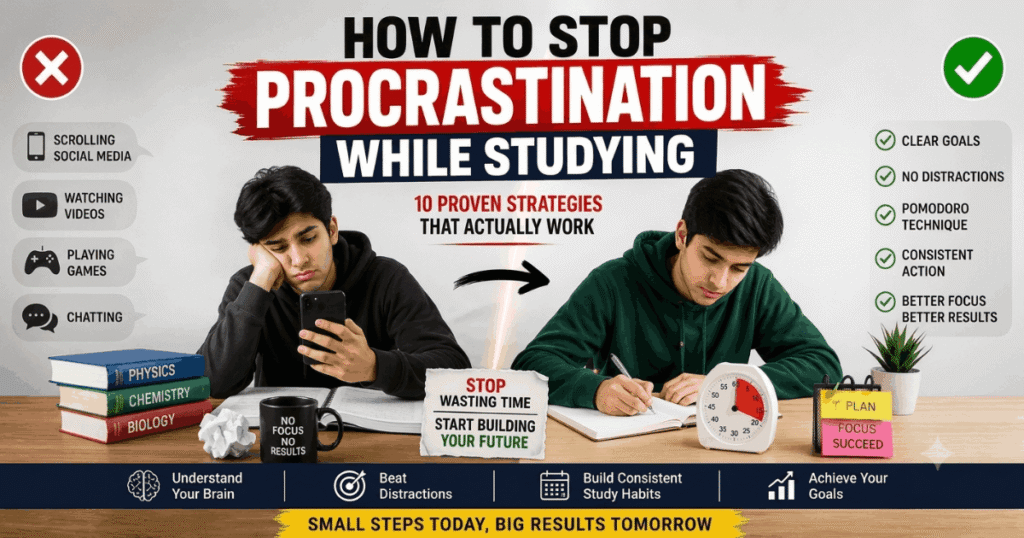
Learn how to stop procrastination while studying using proven techniques, psychology-based methods, and practical student strategies for better focus and results.
Do you ever open your textbooks with plans to study but instead find yourself scrolling through social media, watching YouTube videos, or organizing your desk? If so, you’re not alone. Many students think of procrastination as laziness; however, this isn’t true.
Procrastination is an emotional response to distractions. It is based on instant gratification rather than long-term achievement by the brain. If you are getting ready to take Matric, Intermediate, MDCAT, ECAT, University Exams or CSS, learning how to overcome interfering with procrastination while studying will help your concentration, productivity and performance.
This guide explains the reasons for procrastinating during studying and includes practical research-supported methods for defeating procrastination in your study habits and for developing habits for continual success.
What Is Procrastination While Studying?
Procrastination while studying is the habit of delaying or avoiding study task despite being aware that it may eventually cause you stress, low performance, or fail to make the deadline. A lot of people who don’t start doing their assignments tend to do things that will give them instant gratification, like being on social media, watching videos, and/or talking to friends.
Procrastination differs from taking an intentionally planned break because it is a completely unnecessary delay that continues to make it harder for you to study in the future.
Why Do Students Procrastinate?

Many students want to know why they keep procrastinating and delaying when they are getting close to their tests. The short answer is that procrastination is an emotional response rather than a problem with time management.
Here are the most common reasons for procrastination:
1. Afraid To Fail
Some students are delaying themselves from studying because of the fear that they may not do well. Rather than try and find out if they may not do well on their exams, they are just avoiding starting on their exams.
2. Need Perfection
A lot of times, students wait for the “perfect time” or think that their notes must be “perfect”. This leads them to no progress at all.
To put it another way: Anything that is completed is better than anything that is perfect.
3. Smartphone and Social Media Distractions
Once you look at your phone for just one minute, it has turned into one hour of scrolling. The apps are made to grab your attention with unlimited notifications and instant entertainment until you don’t even realize that you lost track of time.
4. Overwhelming Tasks
When you look at an entire syllabus, it may feel overwhelming. If you see a task that is so big, your brain wants to run away from that task.
Creating a realistic study schedule can make large tasks feel more manageable. Read our Time Management for Students guide to learn how to plan your study sessions more effectively.
5. Lack of Clear Goals
If you tell yourself that the goal is “I am going to study today,” it is easy to get distracted and not accomplish that goal. Clear and specific goals will help you start your studying and stay focused.
The Science Behind Procrastination
Once you understand the psychology behind procrastination, you will better be able to overcome it. Research shows that procrastination is a psychological behavior Procrastination Psychology that affects student performance.
Your brain is always making decisions for rewards:
Short-term rewards, such as social media, gaming, talking to friends, or anything that entertains you.
Long-term rewards, such as good grades, passing your exams, and having a future career.
Because many of the rewards in studying take a long time to receive, they are not as appealing to you as the other rewards that are available right away.
Dopamine, which is a chemical released in the brain when you receive a reward, also affects how you make decisions and whether or not you will complete your goal. You get quick bursts of dopamine from using social media and slower bursts of dopamine from studying.
The good news is that you can train your brain. You can help your brain start to like studying and not procrastinate by making it easier for you to get started and giving yourself small rewards as you make progress while you study.
Signs that You are Procrastinating Instead of Studying
If you find yourself doing the following things regularly, it is likely that you are procrastinating:
- Planning more than you are studying
- Waiting until the last minute to study for exams
- Checking your phone every couple of minutes Saying to yourself, “One more video, and then I’ll start studying.
- Cleaning your room or organizing your desk instead of opening your books.
- Feeling guilty for not studying but still not starting to study.
By recognizing these patterns, you are taking the first step toward effecting change.
Impact of Procrastination on Exam Performance
Procrastinating on your study time will not only decrease your overall study time, but it can also impact the quality of what you learn.
Procrastinators tend to exhibit the following characteristics prior to an exam:
- Increased levels of stress before the exam date
- Difficulty concentrating
- Procrastinating until the last moment and cramming
- Decreased self-confidence
- Difficulty remembering information
For instance, a student gets ready for the MDCAT Exam. Instead of studying one chapter per day, the student has procrastinated for several weeks prior to the date of their exam. Now, as the exam date approaches, this student must cram multiple chapters within a very short period of time. As a result, the student has an increased level of stress, has higher anxiety levels and has difficulty retaining the material.
How to Stop Procrastination While Studying
1. Start with the Five-Minute Rule
One of the ways to get started is to tell yourself that you will study for just five minutes.
This is because getting started is often the part of studying. Once you have started studying you are more likely to continue studying.
Of thinking to yourself:
“I have to study for three hours.”
You should say to yourself:
“I will study for five minutes.”
This is because small beginnings create momentum for your studying.
2. Break Big Tasks into Small Steps
Large tasks feel overwhelming.
Before you start studying, don’t say
❌ I need to study Biology
you break it down into smaller tasks like:
- Read Chapter 3
- Highlight points
- Solve five choice questions
- Review my notes for ten minutes
When you complete these tasks it gives your brain a sense of achievement, which makes it easier for you to keep studying Biology. A clear goal removes confusion and increases focus.
3. Turn Off All Distractions Before You Start
I believe that environment really matters when start studying.
Before every study session make sure to:
- Silence your phone or keep it in another room to avoid distractions
- Close any browser tabs
- Turn off notifications
- Keep only study materials on desk
By reducing distractions, you find it easier to stay focused on studying. Your environment should “force” you to study.
If you need digital tools to block distractions and improve focus, check out our guide on Best Study Apps for Students.
4. Use the Pomodoro Technique
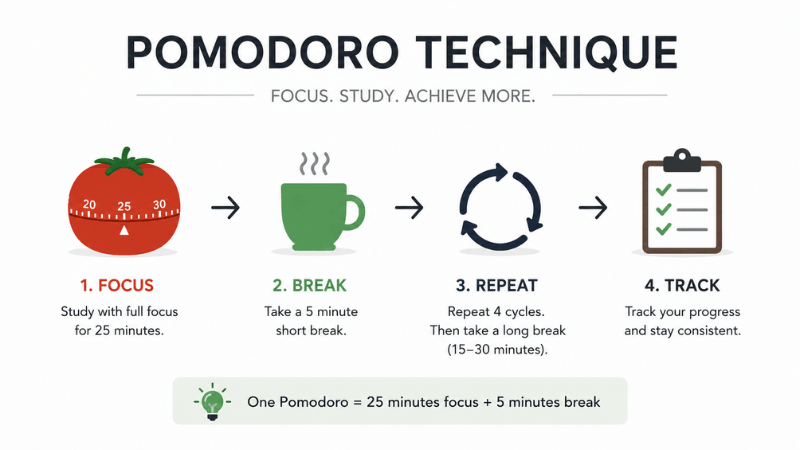
I think that the Pomodoro Technique is one of the effective ways to stop procrastination while studying. Don’t think about studying for 3 hours.
Just start with one Pomodoro (25 minutes).
The method is simple:
- study for 25 minutes
- Then take a 5-minute break
- repeat this process four times
- After that take a break of 15–30 minutes
you find that short study sessions feel less intimidating, which helps you to stop procrastination while studying the Pomodoro Technique. If you’re new to this method, check out our complete guide on the Pomodoro Technique to learn how to use it effectively.
5. Progress Review
After every session, ask yourself:
- What did I accomplish?
- Did I maintain focus?
- How can I do better next time?
This will build your awareness and discipline in the long run.
The STOP Framework to Beat Procrastination
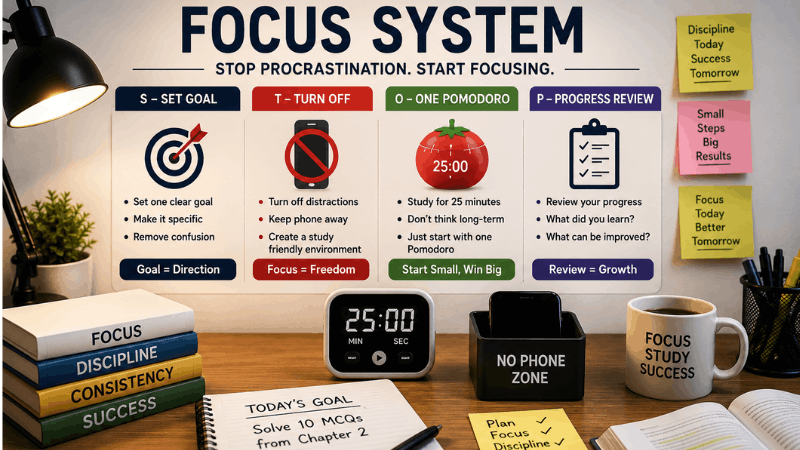
Many students struggle to maintain consistency because they do not use a simple system. The STOP Framework can help to initiate studying when someone is feeling lazy, distracted, or unmotivated. The STOP framework provides a simple four-step solution for implementing anti-procrastination techniques into a smooth way to support concentration and consistency before each study session.
S – Set One Goal:
Set a specific study goal.
T – Turn Off Distractions:
Silence your phone and create an attractive and organized study environment.
O – One Pomodoro:
Commit to a single, uninterrupted 25-minute period of concentration while studying.
P – Progress Review:
Review your progress at the end of each Pomodoro and set up for your next Pomodoro.
Anti-Laziness Hack: Two-Minute Rule
Do things right away if the task can take less than two minutes to complete.
Examples:
- Open your book
- Write today’s topic
- Set a timer
- Sit down at your study desk
By completing these small tasks first you eliminate the mental barrier that prevents you from getting into the right headspace so you won’t have to worry about how long you’re taking to get into studying mode.
Habit Stacking for a Regular Study Routine
Habit stacking allows you to build habits by connecting them with things you do every day.
Examples of habit stacking for studying:
- After you eat breakfast → study for 25 minutes
- After school/college → revise notes
- After Maghrib (the Muslim evening prayer) → answer practice MCQs
- Before going to bed → do some last-minute revisions
By habit stacking, you create natural discipline w/o depending on your feelings or how motivated you feel to study at that time.
Comparison Table — Procrastination vs Smart Study Behavior
| Procrastination Habit | Better Study Habit |
| Checking your phone constantly | Keep your phone out of sight |
| Waiting for an urge to study | Start by using the 5-minute rule ( just make a start and then see how it goes) |
| Trying to study everything all at once | Break it down into small jobs/tasks |
| Thinking about it for too long | Just get started immediately |
| Long study sessions that weren’t planned | Use the Pomodoro Method |
Daily Anti-Procrastination Checklist – Follow before your study session each day
✔️ I have one specific goal
✔️ I have put my phone away from me
✔️ My study area is clean
✔️ I have started a timer
✔️ I will only study for 25 minutes
Use this checklist each day to get into the mindset to study consistently. These simple habits not only reduce procrastination but also help you become a more productive student. Read our guide on How to Be Productive as a Student for more practical strategies.
7 Day Anti Procrastination Challenge (Week 1)
Objective: To train your brain to develop consistent study habits on a weekly basis.
Day 1: Spend 25 minutes studying without any kind of pressure.
Day 2: Remove your mobile device from your environment while studying.
Day 3: Break one subject up into lots of smaller things to do.
Day 4: Do two Pomodoros for a total of 50 minutes.
Day 5: Revisit what you learned yesterday.
Day 6: Study without expecting to feel motivated.
Day 7: Review and repeat the successful things you did above.
Mistakes Students Make
1. Waiting To Be in A “Mood” To Study
2. Trying To Multitask
3. Doing Too Much Planning
4. Set Unreasonable Study goal
FAQs – People also Asks
Is procrastination laziness?
Procrastination is usually caused by fear or distraction or a lack of clarity about what to do.
Can procrastination be completely removed?
Procrastination can be Reduced significantly with good habits and systems that work for you.
H3: How long does it take to stop procrastination?
Most students see improvement within 7 to 14 days of practicing every day.
Conclusion
Procrastination is a habit, not a character flaw; therefore, it can be changed.
By learning how to control your environment, break down tasks into smaller manageable pieces, and take action before you are ready, you will continue to develop your ability to focus.
The bottom line is simple:
Start small, start now, and be consistent!