

Learn how to study effectively with proven study techniques, time management tips, and learning strategies to improve academic performance and exam results.
Have you been studying all day long only to forget everything when it is time to take an exam? The reason you do not remember anything is because of the way you are studying, not the amount of effort you put in to study. Through research in cognitive science, it has been discovered that students continue to use study methods that are not effective, such as re-reading and highlighting, which give students a false sense of learning. Many students struggle to understand how to study effectively and retain information for a longer period.
This guide will provide you with science-proven methods to study effectively, especially designed for students in Pakistan.
Reasons Traditional Study Methods Are Not Effective
In Pakistan, most students use the “ratta system” when studying, which is rote learning. They focus on memorization with no understanding of what they are learning.
Research shows that re-reading and highlighting are both considered “low utility methods.” Students may feel confident going into the exam, yet underperform.
Why Does This Happen?
You can recognise information that you have read, but can you retrieve that information under test conditions?
The Science Behind How to Study Effectively
Your brain works best when you retrieve information (rather than just read), have spaced practice with repeated retrivals over time, and apply your knowledge actively.
The Forgetting Curve: Why You Forget Things Fast
A man named Hermann Ebbinghaus, who is a psychologist from Germany did some research. He found out that students forget a lot of things they learned, up to 70 percent within one day if they do not go over it again. This is called the Forgetting Curve.
The Forgetting Curve is a problem because it means that students forget things very quickly.
Your brain gets rid of information that you do not use.
So what can you do about the Forgetting Curve:
You should use something called spaced repetition to stop forgetting things.
The key question to ask yourself is: “ do students who actively test themselves remember information more accurately compared to those who only re-read their notes as a result of using active recall?” The answer to this question is: “Yes. The students who used active recall in the test performed 30-50% better compared to the students who were only tested using the technique of re-reading their notes.”
Find Your Study Style (most student ignore this)
Before you pick a study technique you need to figure out how you learn things.
If you use a study method that’s not right, for you it does not matter how hard you try you will not get good results.
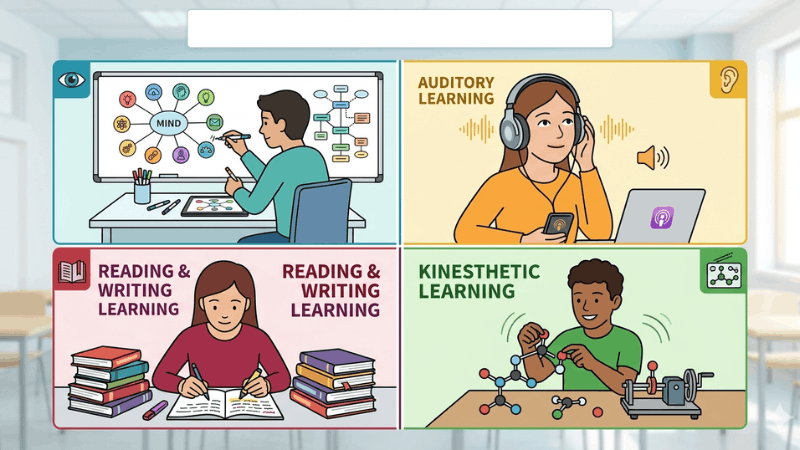
Types of learners:
- Visual learners learn better when they see diagrams and charts and mind maps
- Auditory learners understand things better when they listen to someone or explain something themselves
- Reading and writing learners prefer to take notes and make summaries and read written content
- Kinesthetic learners learn best when they actually do things and solve problems
Here is a tip:
You should find out what kind of learner you are and then use a study method that works for you.
For example
if you are a learner you should use mind maps and diagrams instead of writing down long notes.
Cognitive Load: Don’t Overload Your Brain
The amount of data that can be processed by the brain at any given moment is restricted/ limited and referred to as cognitive load.
Trying to cram too much material into the memory system at once results in:
- An oversaturation of the mind
- Quick forgetting of the newly learned content
- Loss of concentration
Use this method for efficient studying:
- Divide the subject matter into small pieces.
- Study each principle separately.
- Take a brief time out after you have studied each concept.
The Steps to Study Effectively
Step #1 – Use Active Recall (The Most Effective Method)
Active Recall means
Trying to remember the information potentially without looking at your notes.
Science says
that Active Recall strengthens your memory by the “Testing Effect.” Tests give you a stronger memory of the material than simply re-reading your notes.
To use active recall, close your book and write everything down that you can remember. You can also follow a guide on how to use active recall
How to apply
- To use active recall, close your book and
- write everything down that you can remember.
- Solve past paper questions
Step 2: Use Spaced Repetition
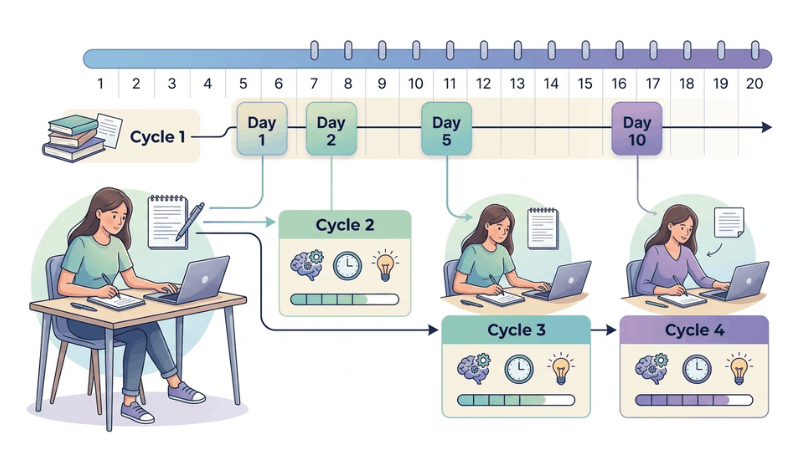
Do not try to learn everything at once Spaced Repetition is better because it helps you remember things for a longer time.
If you want to apply this properly, you can follow a spaced repetition study plan.
Research shows us that
Spaced Repetition really helps you remember things for longer time.
Here is a plan:
- Day 1 → Study something
- Day 2 → Go over what you studied
- Day 5 → Go over what you studied again
- Day 10 → Go over what you studied one more time
This is better than trying to study everything the night
Step 3: Avoid Passive Studying
passive method:
- Re-reading something over and over
- Highlighting things in a book
- Only watching videos
The truth is:
These methods make you think you are learning but you are not really understanding things.
Step 4: Use the Feynman Technique to learn
If you cannot explain something in a simple way then you do not really understand it. The Feynman Technique is one of the most effective study methods for improving understanding and long-term retention. Instead of memorizing information, this approach encourages you to explain concepts in simple terms, helping you identify knowledge gaps and strengthen your learning. To learn the complete process, read our detailed guide on the Feynman Technique.
Here is how to do it:
Teach someone what you learned
Use simple words
Find the parts that you do not understand well
Step 5: Improve your focus with short study sessions
Use study sessions that are
- 25 to 30 minutes long and focus only on studying. Strong concentration is essential for effective studying, so explore our guide on how to improve concentration and stay focused during study sessions.
This will help you:
- pay attention
- remember things
- have more energy
Step 6: Combine methods, for the best results
The best way to learn is when you use:
- Active Recall
- Spaced Repetition
- Teaching method together
Research shows combining techniques improves learning efficiency. Research shows that regular breaks can improve focus and productivity. (Source: Harvard University)
How Modern Learning Platforms are Effective: A Real Case Study
This is how modern platforms like Khan Academy work:
- Use of Active Quiz-Style Questions
- Step-by-Step Structured Learning
- Use of Immediate Output or Feedback in Learning
why its work:
- Students Are Actively Involved with their Learning
- Continuous Testing Increases Retention
- Learning Becomes an Interactive Process
And, this is what the research shows as well.
Pakistan-Focused Study Strategy
In Pakistan, most research studies focus on other countries; however, a system designed around Pakistani students should take into consideration what Pakistani students experience and what their performance relative to their environment is.
For all students taking Matric or FSC Entry Test Examinations:
- Focus on Past Exam Papers + Concepts
- Use Active Recall (rather than “ratta”)
- Review Important Questions Repeatedly
For Entry Test students:
- Daily MCQ Practice Questions
- Time-Based Question Solving
- Review Weakest Subject Areas
Biggest mistake in Pakistan:
The biggest mistake made by Students in Pakistan is Last-minute cramming:
Problem with Last-Minute Cramming:
- Retention only in short-term memory
- Increased stress and reaction to stress
- Poor overall exam performance
The Best Study Routine for Retaining Knowledge:
When you study, the best way to retain that information is to use a scientifically proven sequence of Study.
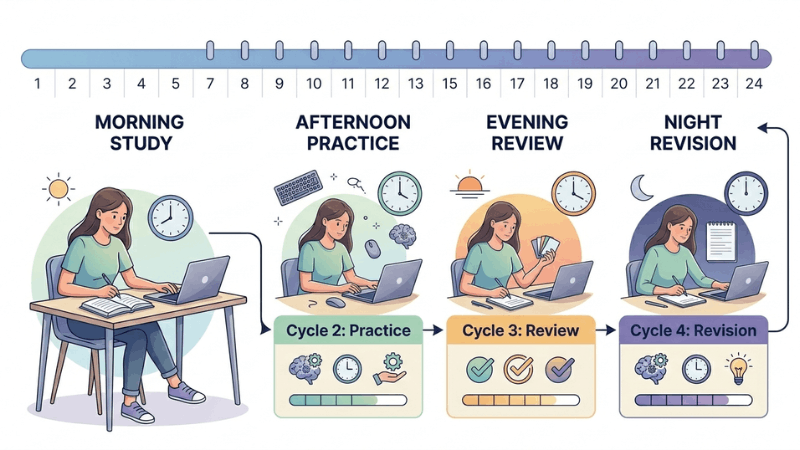
- Morning: “Learn” New Content
- Afternoon: “Practice” New Content (Recall)
- Evening: “Review” *(White Board/ Study) Examples
- Night: Only a Quick Review of All Content
And, this matches how your brain consolidates what you are studying.
Mistakes Students must avoid:
- Studying for long hours without breaks
- ignoring revision
- Doing Too Many things at Once
- Reading Without Thinking
FAQ (People Also Ask)
What is the Best Study Methods to Study Effectively?
The best method of study effectively has been shown scientifically to be the combination of Active Recall and Spaced Repetition.
How do I not forget what I study?
Using Spaced Repetition allows one to study at times other than just cramming, then you’ll retain what you studied longer.
What’s the average time a student spends studying each day?
About three to five hours when focused enough time is spent studying during that time.
Does rote learning work?
In the short term, it works alright; in the long term, you don’t retain the same information as if you learned it using active/reasoned thought.
What can students in Pakistan do to improve their study performance?
Concept-based approaches, past exams, and using Recall methods will improve their studies.
Conclusion:Study Smart Using Science
The biggest change you need to make is this:
- you need to stop studying harder
- and start studying smarter.
Some things are really clear from research:
- Active learning is better than sitting and listening
- Studying a bit every day is better than trying to learn everything at once
- Explaining things to someone really helps you understand them
- If you try even one of these things today you will start to see your results get better. By following these tips, you can learn how to study effectively and achieve better academic results.
Final Insight
In the future students who know how to learn will do better than students who just try to remember things.
- Your success is not about being talent
- it is, about using the right way of studying.