

Learn a practical spaced repetition study plan for students. Boost long-term memory, beat cramming, and study smarter for exams.
Pakistani students often study for long hours,yet forget most of what they learn before exams. This isn’t a motivation problem—it’s a study method problem.
The solution?
A spaced repetition study plan—a science-backed technique that helps students remember information for the long term instead of cramming and forgetting.
Spaced repetition becomes more effective when combined with an active recall study method for Pakistani students, a proven technique widely used by high performing students.
In this guide, you’ll learn:
- What spaced repetition study plan is (in simple terms).
- Why it works better than traditional study methods.
- A step-by-step spaced repetition study plan for students
- How Pakistani students can use it for board exams, entry tests, and university studies.
This article is beginner-friendly and designed especially for students in Pakistan.
- What Is Spaced Repetition? (Simple Explanation)
- Science Behind Spaced Repetition
- Why Spaced Repetition Works for Pakistani Students
- Spaced Repetition vs Traditional Cramming
- Weekly Spaced Repetition Study Schedule (Example)
- How to Combine Spaced Repetition with Active Recall
- Micro-Revision Technique for Pakistani Students
- Gamification & Motivation Tips
- Study Environment Tips for Pakistani Students
- Real Brand Case Study: How Anki Uses Spaced Repetition
- Best Tools for Spaced Repetition (Optional)
- Common Mistakes Students Make
- Why Most Students Fail This Method
- People Also Ask (FAQs)
- Conclusion: Study Smarter, Not Longer
What Is Spaced Repetition? (Simple Explanation)
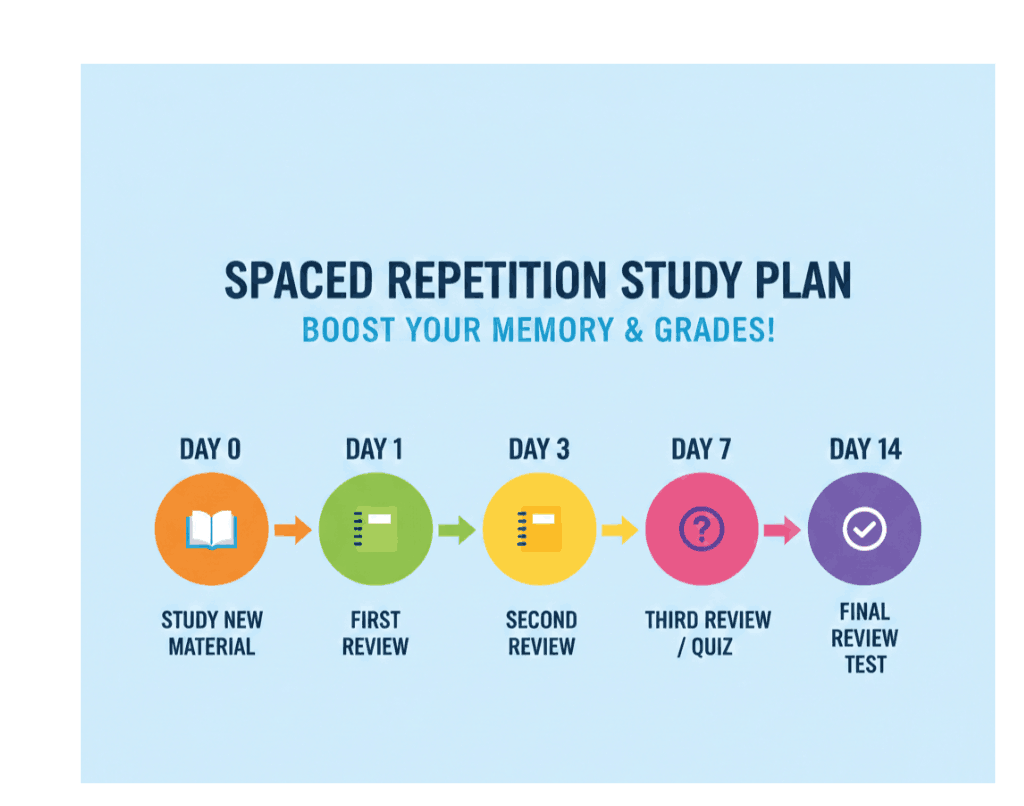
Spaced repetition is a study technique where you review information at increasing time gaps instead of repeating it every day.
Instead of this ❌
- Study today → forget tomorrow → panic before exams
You do this ✅
- Study → review after 1 day → 3 days → 7 days → 14 days
Each review strengthens memory.
This method is based on the Forgetting Curve, a concept discovered by psychologist Hermann Ebbinghaus, which shows that humans forget information rapidly unless it’s reviewed at the right time.
Science Behind Spaced Repetition
Spaced repetition works because our brain gets connections over time.
When we recall information at intervals our brain thinks it is important and moves it from short term to long term memory. This helps make our brain cells talk better to each other so we can get the information easily during exams.
That is why recalling again and again at certain times is way better, than just reading notes again.
Why Spaced Repetition Works for Pakistani Students
Pakistani education systems rely heavily on:
- Long syllabus
- Memory-based exams
- Last-minute cramming
Spaced repetition fits perfectly because it:
- Reduces exam stress
- Saves study time
- Improves long-term recall
Works for FSc, Matric, Intermediate, MDCAT, ECAT, CSS, and university exams. If you’re looking for a complete exam strategy, read our guide on How to Prepare for Exams Effectively to combine planning, revision, and smart study techniques.
Instead of studying 10 hours a day before exams, students using spaced repetition study plan often study 1–2 hours daily with better results.
Spaced Repetition vs Traditional Cramming
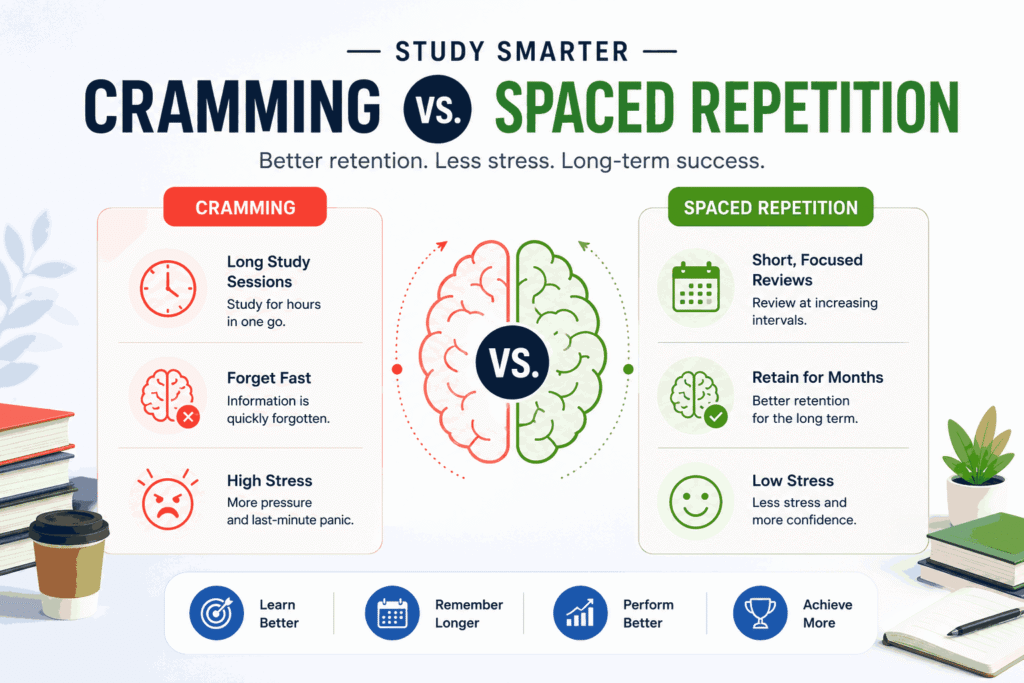
Comparison between traditional study and spaced repetition
| Traditional Study | Spaced Repetition |
| Long study sessions | Short, focused reviews |
| Forget after exams | Retain for month |
| High stress | Low stress |
| Passive reading | Active recall |
Step by step spaced repetition study plan for students
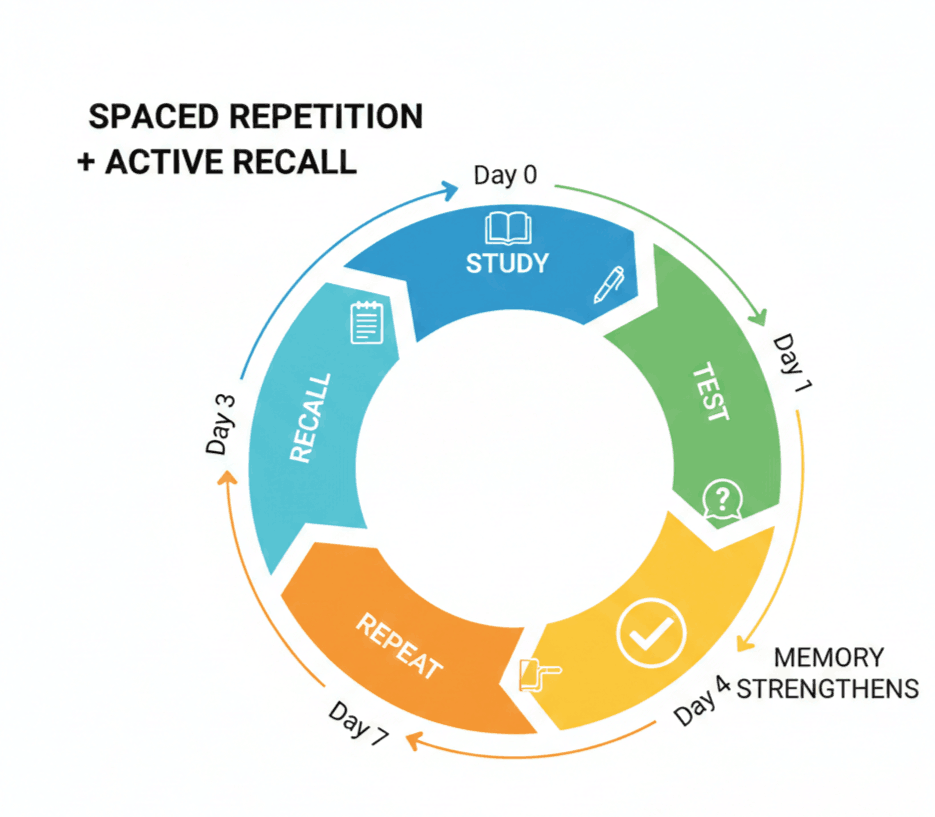
Step 1: Study the Topic Normally (Day 0)
- Read the chapter or lecture once
- Understand concepts (not memorization)
- Duration: 20–40 minutesTip:
- Avoid highlighting too much. Focus on understanding.
- If you struggle to understand concepts instead of memorizing them, read our How to Study Effectively guide shares practical techniques to improve comprehension and learning efficiency.
Step 2: First Review (After 24 Hours)
- Close the book
- Recall main points from memory
- Write short answers or explain aloud
- ⏱ Time: 10–15 minutes
Step 3: Second Review (After 3 Days)
- Test yourself again
- Focus on weak areas
- Use short notes or flashcards
- ⏱ Time: 10 minutes
Step 4: Third Review (After 7 Days)
- Attempt questions without notes
- Mix topics (interleaving)
- ⏱ Time: 5–10 minutes
Step 5: Final Review (After 14–21 Days)
- Quick scan
- Solve exam-style questionsT
- this final review locks information into long-term memory.
Weekly Spaced Repetition Study Schedule (Example)
| Day | Topic |
| Monday | New topic |
| Tuesday | Review Monday’s topic |
| Wednesday | New topic |
| Thursday | Review Monday + Wednesday |
| Friday | New topic |
| Saturday | Review all weak topics |
| Sunday | Light revision or rest |
This schedule works well for school and college students in Pakistan.
How to Combine Spaced Repetition with Active Recall
“Using active recall alongside spaced repetition significantly improves memory retention.”. Instead of reading your notes:
- Close the book and try to write answers from memory
- Teach the topic to someone else “ If explaining concepts feels difficult, try the Feynman Technique. It helps you simplify complex topics and identify knowledge gaps before your next spaced repetition review.
- Write the question on one side of a card and the answer on the other to practice recall.”
✅ This method really helps to make the memory stronger than using spaced repetition by itself. It is a way to improve memory and it works better than spaced repetition alone. The memory gets stronger, with this method.
This combination is really good, for helping with memory. The combination works well to improve memory.
Micro-Revision Technique for Pakistani Students
For very busy students, try the 5-minute daily revision:
- Spend 5–10 minutes reviewing formulas, definitions, or key concepts learned in class
“This technique is particularly useful for short exams or subjects with heavy content, such as Physics, Chemistry, and Biology.”
Purpose:
- Helps retain knowledge without long study sessions
Gamification & Motivation Tips
Encouraged turning spaced repetition into a game:
- Track streaks
- Reward yourself for weekly completion
I think it is really important to study for 15 to 20 minutes every day. This is much better than trying to learn everything at the minute. Studying for 15 to 20 minutes daily is a habit. It helps you to remember things more easily than if you were to try to cram all of your studying into one short period of time. Daily studying for 15 to 20 minutes beats last-minute cramming. Consistency becomes much easier when you can stay focused. Check out our How to Improve Concentration While Studying article for practical focus-boosting strategies.
The purpose of this is to make the method more engaging and motivational. This makes the method really interesting. It motivates people to do things. The method becomes more engaging and motivational because of this.
Study Environment Tips for Pakistani Students
Added locally relevant advice:
- Study during electricity hours in areas with load-shedding
- Quiet corners at home or libraries
- Study in online peer groups (WhatsApp/Discord)
- Reduce distractions like social media
Purpose:
- Contextualizes the method for Pakistani students’ real-life challenges.
Real Brand Case Study: How Anki Uses Spaced Repetition
Anki, one of the world’s most popular learning apps, is built entirely on spaced repetition.
Medical and engineering students worldwide use Anki because:
- It schedules reviews automatically
- It adapts to memory strength
- It improves exam performance significantly
Many Pakistani MDCAT and ECAT students report higher retention with less study time when using Anki or similar spaced repetition tools.
The takeaway?
The method works across countries, systems, and difficulty levels.
Best Tools for Spaced Repetition (Optional)
You don’t need apps, but they help.
Popular options:
- Anki (advanced users)
- Notion (manual scheduling)
- Simple notebook + calendar
Beginners can start without any app using a notebook and reminder system.
Common Mistakes Students Make
❌ Reviewing too late
❌ Re-reading instead of recalling
❌ Studying everything daily
❌ No fixed review schedule
Spaced repetition study plan only works when reviews are planned.
Why Most Students Fail This Method
Most students fail at repetition not because it is hard but because they don’t stick to the schedule.
They. Put off reviews or go back to cramming right before exams.
If you don’t review at the time every day you will forget what you learned and spaced repetition study plan won’t work.
The key to making spaced repetition work is to be consistent, with your reviews.
You have to make reviewing a habit.
Spaced repetition works if you keep reviewing what you learned at the times.
People Also Ask (FAQs)
Is spaced repetition study plan good for exams?
Yes. It is one of the most effective techniques for exam preparation and long-term memory.
How much time does spaced repetition take daily?
Usually 30–90 minutes, depending on subjects and syllabus size .
Can school students use spaced repetition study plan?
Absolutely. It works for Matric, O-Levels, FSC, and even middle school.
Is spaced repetition study plan better than cramming?
Yes. Cramming leads to quick forgetting, while spaced repetition builds lasting memory.
Do I need apps for spaced repetition?
No. Apps help, but a notebook and calendar are enough.
Conclusion: Study Smarter, Not Longer
Spaced repetition is not a shortcut—it’s a smart system.
For Pakistani students struggling with heavy syllabi and exam pressure, this method offers clarity, control, and confidence.
When combined with active recall, spaced repetition becomes a powerful learning strategy that not only improves grades but also builds real understanding.
As education becomes more competitive, students who use science-based study methods will always stay ahead.
Start small. Stay consistent.
Your future self will thank you.