

Learn the active recall method for Pakistani students. Science-backed tips, real examples, and exam-ready strategies to improve memory fast. Pakistani students often complain about the same problem: “I study for hours, but I forget everything in exams.”
The issue is usually not lack of hard work, but using the wrong study method. Most students rely on passive techniques like rereading books or highlighting notes methods that feel productive but fail in real exams. This is where the active recall method comes in. If you are new to study techniques, first learn How to Study Effectively to build a strong foundation.
This guide is specially designed for Matric, FSc, MDCAT, ECAT, and university students in Pakistan.
- What Is the Active Recall Method? (Simple Explanation)
- The Science: Why Recall Beats Rereading
- How to Use Active Recall: Step-by-Step
- A Real Example: Anki and the Active Recall Habit
- How Pakistani Students Can Use Active Recall Method (Step-by-Step)
- Real Brand Case Study: How Top Students Use Active Recall Method
- Best Tools for Active Recall (Pakistan-Friendly)
- Common Mistakes Pakistani Students Make with Active Recall
- Daily Study Routine for Pakistani Students Using Active Recall
- FAQs – People Also Ask
- Final Thoughts: The Future of Studying in Pakistan
What Is the Active Recall Method? (Simple Explanation)
Active recall is a science-based learning technique where you actively try to remember information from memory, instead of passively reviewing it.
Rereading a chapter or highlighting notes feels productive, but it mostly builds familiarity, not memory. Ratta creates the same illusion: the material feels known right up until the exam paper asks you to produce it without a prompt in front of you.
Active recall flips the script. Instead of looking at the answer, you close the book and try to produce it yourself—through a question, a blank page, or an explanation said out loud. If it feels difficult, don’t worry—you’re challenging your brain in a way that helps the information stay with you longer.
The Science: Why Recall Beats Rereading
This isn’t a study tip—it’s one of the most replicated findings in cognitive psychology. In a landmark 2006 study published in the journal Science, researchers Henry Roediger and Jeffrey Karpicke had students learn a passage either by rereading it repeatedly or by testing themselves on it once. A week later, the group that had tested itself remembered 80% of the material, compared to just 36% for the rereading group—more than double, from the same amount of study time.
A 2013 review of study techniques in Psychological Science in the Public Interest rated practice testing as one of the few methods with genuinely strong evidence behind it, across ages, subjects, and formats. That’s why active recall is now standard advice in medical schools and top universities worldwide—not because it’s trendy, but because it’s one of the most tested findings in learning science.
How to Use Active Recall: Step-by-Step
- Read once, briefly. Go through a topic for 15–20 minutes to understand it. Don’t reread it multiple times.
- Close the book. No peeking. This is where the actual learning happens.
- Ask yourself real questions. “What are the three causes of X?” “Can I explain this without notes?”
- Answer out loud or on paper. Speaking or writing forces full retrieval, not partial recognition.
- Verify and correct. Open the book, mark what you missed, and correct only the gaps.
For Biology Students
Turn each heading into a question. Instead of rereading the photosynthesis chapter, ask yourself, “Explain photosynthesis without looking,” then check your answer against the book.
For Math and ECAT Prep
Active recall looks a little different here: cover the solved example and try to solve the problem from the first step, using only the question. Getting stuck is normal—it tells you exactly which step needs review.
Active recall is supported by the Testing Effect, a well-documented learning principle.
A Real Example: Anki and the Active Recall Habit
Anki, a free flashcard app, is built entirely around active recall and spaced repetition. It’s widely used by medical students, including many MDCAT and MBBS students in Pakistan, specifically because it forces retrieval instead of rereading. You don’t need an app to use this method—a notebook with questions on one side and answers on the other works on the same principle. The tool itself isn’t what makes active recall work—the real benefit comes from actively trying to remember the information. Anki just makes it easier to repeat consistently.
How Pakistani Students Can Use Active Recall Method (Step-by-Step)
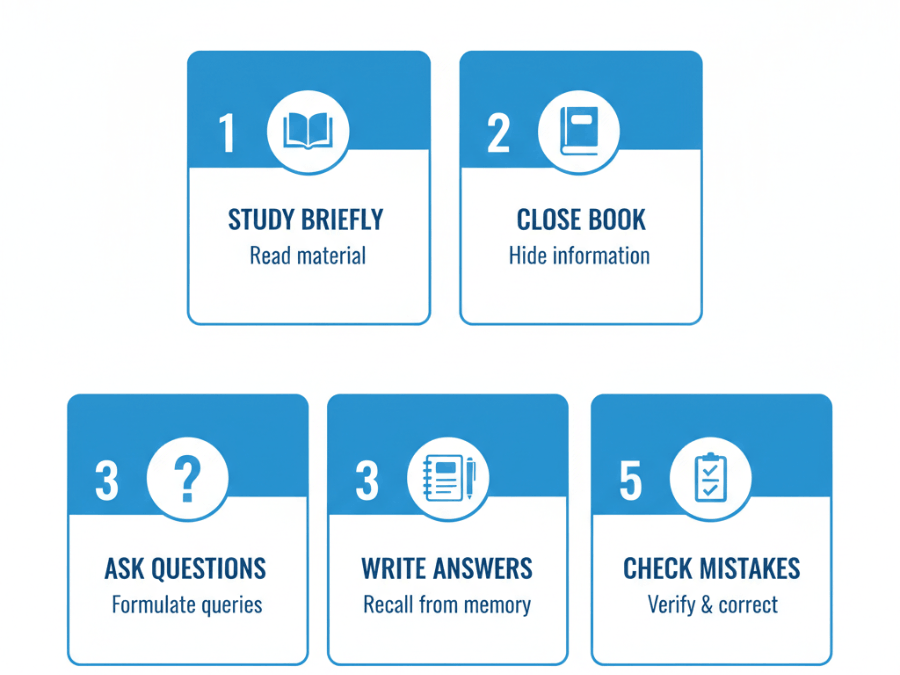
Step 1: Study Normally (Short Time)
- Read a topic once to understand it (10–20 minutes max).
Step 2: Close the Book
- Put the book away. No cheating.
Step 3: Ask Yourself Questions
Examples:
- What are the main points?
- Can I explain this topic without notes?
- What questions can come in the exam?
Step 4: Write or Speak Answers
- Write on paper
- Explain aloud as if teaching someone
Step 5: Check & Fix Gaps
- Open the book, identify mistakes, and improve weak areas.
- Repeat this cycle daily.
Real Brand Case Study: How Top Students Use Active Recall Method
Case Study: Anki Flashcards (Global Learning Tool)

Anki is a flashcard app based entirely on active recall + spaced repetition.
Used by:
- Medical students
- Engineering students
- Competitive exam toppers worldwide
Result:
“According to user reports and learning communities, Anki users often reduce study time while improving long-term retention.”
Users report:
- Studying less time
- Remembering more information
- Better exam confidence
Pakistani students can use similar methods even without apps—with notebooks or homemade flashcards.
Best Tools for Active Recall (Pakistan-Friendly)
You don’t need expensive subscriptions.
Free & Practical Options
- Notebook-based Q&A list
- Past papers
- Self-made flashcards
- Whiteboard explanation method
Common Mistakes Pakistani Students Make with Active Recall
Studying without understanding
Active recall works after basic understanding, not before.
Avoiding difficulty
Struggling is a part of the learning process. “If recalling information is too easy, long-term memory retention becomes weak.”
Not Revising Regularly
Without regular revision, memory fades quickly. Spaced revision makes active recall more effective.
Passive Learning
Simply rereading notes is not active recall. You must test yourself without looking at the material.
Inconsistent Practice
Active recall needs regular practice. Doing it only once or twice is not enough.
Daily Study Routine for Pakistani Students Using Active Recall
Many students know what active recall is, but sometimes find it hard to use it every day. Remember, the secret is to practice it daily. By adding recall to your routine, you don’t need extra hours—just the right approach. Trust yourself, and know you can make this powerful habit part of your journey.
2–3 Hour Daily Routine
30 minutes: Learn a topic.
Understand the basics from your book or lecture.
30 minutes: Practice recall.
Close your book. Try to recall or explain what you learned.
15 minutes: Check mistakes.
Look at your answers. Correct errors.
30 minutes: Revise topics.
Use recall to go over past lessons.
15 minutes: Practice papers.
Solve questions from memory. Do not use notes
“A daily routine with active recall helps you learn faster, remember longer, and improve exam performance. It is a powerful study method that builds strong understanding and confidence when used consistently.”
This routine works well for Matric, FSc, MDCAT, ECAT, and university exams. The key is consistency—not perfection. To strengthen your memory even further, try combining active recall with spaced repetition.
FAQs – People Also Ask
Is active recall better than rote learning?
Yes. Active recall improves long-term memory, while rote learning fades quickly after exams.
Can weak students use active recall?
Absolutely. In fact, weak students benefit the most because it fixes learning gaps.
How long does active recall take?
Initially more effort, but overall less time than passive study.
Does active recall work for Pakistani board exams?
Yes. It improves concept clarity and answer writing.
Can I use active recall without apps?
Yes. Paper-based recall works perfectly.
Final Thoughts: The Future of Studying in Pakistan
Active recall method is not just a study technique—it is a smarter way of learning. Active recall is not a shortcut. It is a way to use the time you are already spending studying. In a system where the syllabus is large and competition for MDCAT and top university seats keeps growing, students who focus on studying smarter, not just longer, tend to come out ahead. Start with one subject this week. Close the book and test yourself. Let the struggle help you learn.