
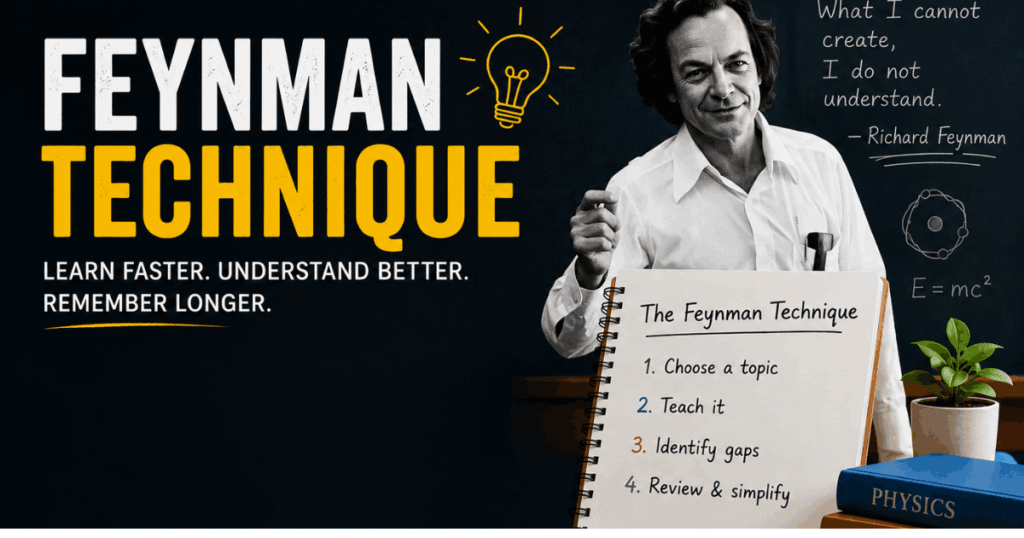
Having trouble understanding complex topics? Find out how Pakistani students can study more effectively and retain more information by using the Feynman Technique. Get started now!
In Pakistan, a lot of students spend a lot of time studying but still get anxious when they sit for their exams. The problem is rarely effort—it’s the method. Many people depend on memorizing information by repetition, which works for remembering things temporarily but doesn’t help when exams ask for real understanding.
The Feynman Technique is a strong way to learn that helps students grasp ideas really well, keep them in mind for a longer time, and do better on tests. This guide shows Pakistani students how to use it in a clear, easy way with actual examples and a realistic study plan.
- What Is the Feynman Technique?
- Why Pakistani Students Struggle With Understanding
- The steps of the Feynman Technique
- Real Example: Using Feynman for Biology
- Why the Feynman Technique Works (Science Behind It)
- Case Study: How Khan Academy Uses Feynman-Style Learning
- Feynman Technique vs Rote Learning (Ratta)
- How to Use the Feynman Technique Daily
- Best Subjects to Use the Feynman Technique
- common mistakes students make
- Feynman Technique Study Tips
- Benefits students notice quickly
- FAQ-People also ask
- conclusion : Study less, understand more
What Is the Feynman Technique?
The Feynman Technique is named after Richard Feynman, a physicist who won a Nobel Prize and was well known for breaking down complicated topics into easy-to-understand explanations.
The core principle:
If you can’t explain something in a simple way, then you haven’t really grasped it.
Instead of reading through again or underlining parts, the Feynman method makes you explain the idea using easy language. This process shows where knowledge is missing and helps improve memory.
Why Pakistani Students Struggle With Understanding
Before we start the steps, let’s talk about the real issue.
In Pakistan, most students face:
Heavy syllabus and exam pressure
Focus on memorization instead of understanding
Limited classroom interaction
Lack of structured study methods
As a result, students often say:
” The best answer is…, but I couldn’t remember it in the exam”
The Feynman Technique addresses this exact issue by changing the focus from just memorizing to truly understanding.
The steps of the Feynman Technique
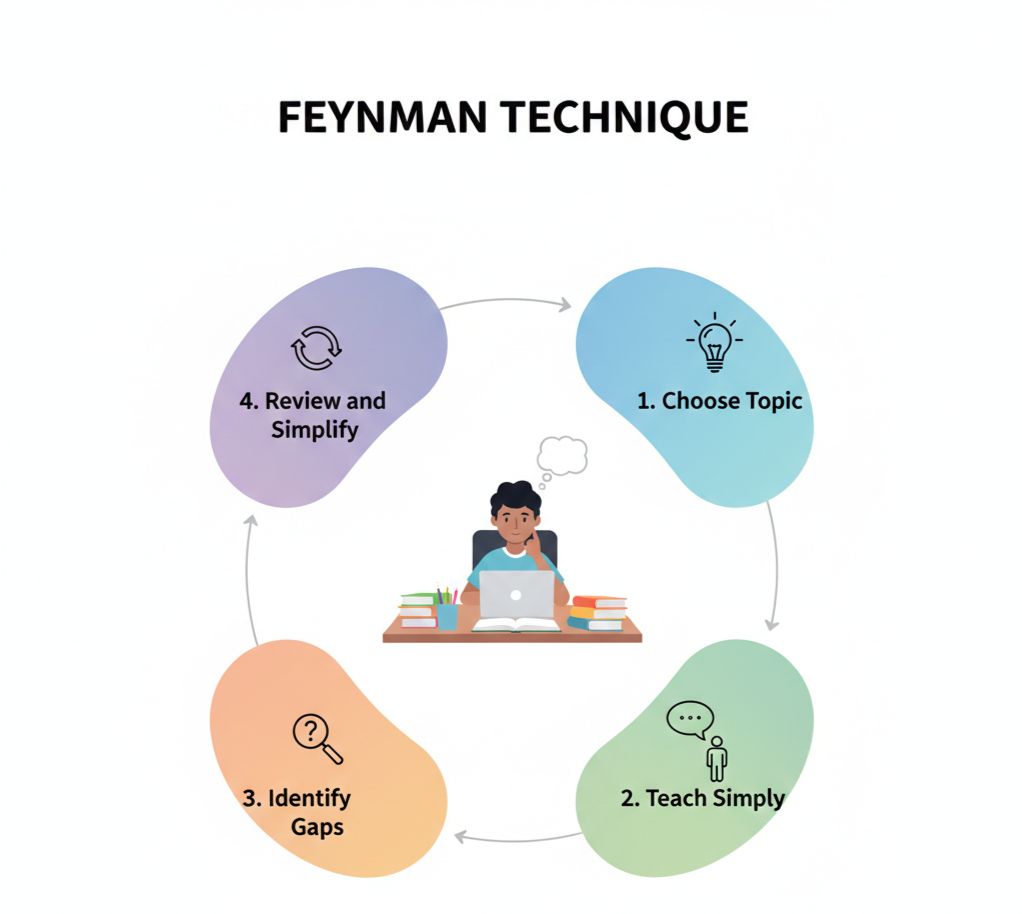
The Feynman Technique works in four simple steps. First, you choose a topic you want to understand better. Then, you explain that topic in your own words as if you’re teaching it to a child. Next, you identify any areas where you’re unclear or confused. Finally, you go back and review the material to strengthen your understanding.
Step 1: Pick a subject you want to learn about.
Pick a specific topic—not a whole chapter.
Examples:
Biology: Photosynthesis
Physics: Newton’s Laws
Math: Quadratic Equations
Write the topic at the top of a blank page.
Step 2: Teach It in Simple Words
Pretend you are teaching a 10-year-old child.
Write all the information you know about the topic in simple English or Urdu. Avoid textbook language.
Example (Biology):
Textbook line:
Photosynthesis is the way plants turn light energy into chemical energy.
Feynman version:
Plants use sunlight to create their own food.
This step makes your brain work to understand and break down information more easily.
Step 3: Identify Knowledge Gaps
While explaining, you’ll get stuck or confused.
That’s the most important moment.
It means:
You don’t fully understand this part yet.
Review the textbook, YouTube lecture, or your notes again and focus on understanding the topics you found difficult.
This step is where real learning happens.
Step 4: Simplify and Repeat
Rewrite the explanation once more, using even easier words. Add examples, analogies, diagrams, and keep repeating the concept until it feels natural and easy to understand.
Real Example: Using Feynman for Biology
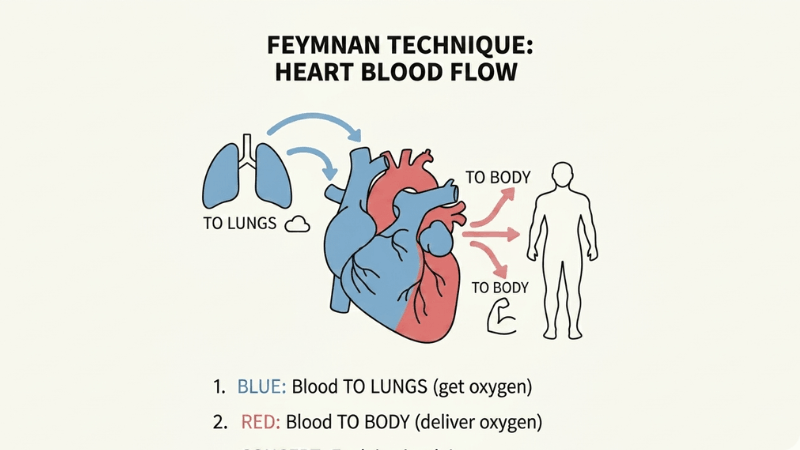
Let’s see how a Pakistani student can use this method for exams.
Topic: Human Heart (Biology)
Typical study method:
Read the chapter, then highlight the important parts, try to memorize what you’ve read, and then forget it later.
Feynman method:
Explain it like this: “The heart is a pump.” It sends blood around the body. The right side of the heart sends blood to the lungs to get oxygen. The left side of the heart sends oxygen-rich blood to the rest of the body. A simple explanation shows a clear understanding. This helps students remember long answers more easily during exams.
Why the Feynman Technique Works (Science Behind It)
Studies in learning science show that when you teach someone else, you remember up to 90% more. Learning by doing is better than just reading. Making things simple helps you remember them longer.
This method uses:
– Active Recall: Trying to remember what you learned
– Deep Processing: Thinking deeply about the material
– Retrieval Practice: Testing yourself to remember
if you want to learn how this works in details, read our guide on active recall study method.
Case Study: How Khan Academy Uses Feynman-Style Learning
Khan Academy became one of the biggest education websites by using a teaching style similar to the Feynman Technique.
Their lessons are designed to use easy language, explain things one step at a time, and show ideas through pictures. Rather than using hard-to-understand academic terms, they explain subjects in a way that a tutor would use to teach someone who is just starting out. This method made it easier for millions of students around the world to grasp tough subjects.
Feynman Technique vs Rote Learning (Ratta)

| Rote Learning | Feynman Technique |
| Memorization | Understanding |
| Short-term memory | Long-term retention |
| Confusion in exams | Clear concepts |
| Passive reading | Active learning |
Pakistani exams are changing. They are slowly moving towards questions that test understanding of the exams material. So it is more important, than ever to understand the concepts of the Pakistani exams. This will help students do well on the exams.
How to Use the Feynman Technique Daily
Here is a simple study plan:
- Daily Study Flow
- Study a topic for 25 minutes using the Pomodoro technique for students, then move to the Feynman explanation.
- Use Feynman explanation for 10 minutes
- Mark weak areas
- Revise the next day
This routine really helps you build concepts as time goes on. It is good for building concepts over time. The routine is very helpful, for building concepts.
Best Subjects to Use the Feynman Technique
This method works well for certain things and I think it is particularly good, for:
Biology
Physics
Chemistry
Mathematics
Computer Science
Economics
It is perfect for board exams, MDCAT, ECAT, and university studies.
common mistakes students make
Students should always try to avoid the mistakes students make.
Mistake 1:
- Writing textbook definitions
- Use simple language instead.
Mistake 2:
- Skipping the “gap finding” step
- This is the most powerful part.
Mistake 3:
- Not practicing regularly
- Consistency is key.
if you struggle with focus while studying, read our tips on improve concentration while studying
Feynman Technique Study Tips
- Explain aloud, not only in writing
- Teach a friend or sibling
- Use diagrams and examples
Combine this method with a spaced repetition study plan for long-term memory.
Benefits students notice quickly
Students really see the benefits quickly. Students who use this method often say that they have these experiences:
- Better understanding of difficult topics
- Faster revision before exams
- Higher confidence in exams
- Reduced exam stress
Within weeks, studying becomes easier and more effective.
FAQ-People also ask
Is the Feynman Technique good for exams?
Yes.The Feynman Technique really helps you understand things better.
Can people who are just starting out use the Feynman Technique?
Yes. The Feynman Technique is actually made for people who are just starting out. It is really helpful for students who have trouble understanding things.
So how long should you use the Feynman Technique each day?
Well you do not have to use the Feynman Technique for a time. Even using the Feynman Technique for 15 to 20 minutes on each subject can give you results.
Is using the Feynman Technique better, than reading something again?
Yes the Feynman Technique is better. Feynman Technique uses active learning, which is a better way to learn.
conclusion : Study less, understand more
A lot of students make a mistake when they study. They think that if they study for a time they will get better results.. That is not true.
The Feynman Technique is a way to study. It helps me change from memorizing things to really understanding them.
As Pakistan’s education system starts focusing more on understanding concepts, knowing these methods will be important, not just helpful. Begin using the Feynman Technique now, and your next study time will feel less hard, quicker, and much better.