
Search “fully funded scholarships for Pakistani students” and you will get dozens of lists. Each one names a hundred programs, a dozen countries, and just as many deadlines.
Most of them overlook the factors that can ultimately influence whether your application is selected.
This guide does. It skips the long list and goes straight to what actually gets an application selected. If you are still deciding whether this is even the right direction for you, our complete guide to choosing the right career path is worth reading first.
What Fully Funded Scholarships Usually Cover
Before comparing programs, it helps to know what “fully funded” actually promises. Coverage varies by program, but most fully funded scholarships include some combination of the following:
- Full tuition fees
- A monthly living stipend
- Travel or airfare to and from your host country
- Health insurance for the duration of your studies
- Accommodation or a housing allowance, depending on the program
Not every scholarship includes all five. Always check the specific program’s benefits page rather than assuming.
The Real Fulbright Number Nobody Tells You
Here is a fact most students never hear. Pakistan has had the largest Fulbright program in the world since 2005, in terms of U.S. government financial contribution, since 2005, according to USEFP, the body that runs it locally.
That is not a small claim. In 2026, it meant 85 Pakistani students and researchers received Fulbright awards: 71 for master’s degrees, 14 for PhDs, and 6 as language teaching fellows. HEC separately funds 25 PhD scholarships a year through the same program.
This funding matters for how you should think about competition. Pakistan is not a small footnote fighting for scraps in these programs. It is, in at least one major case, the biggest player at the table.
Which Scholarship Type Best Matches Your Goals?
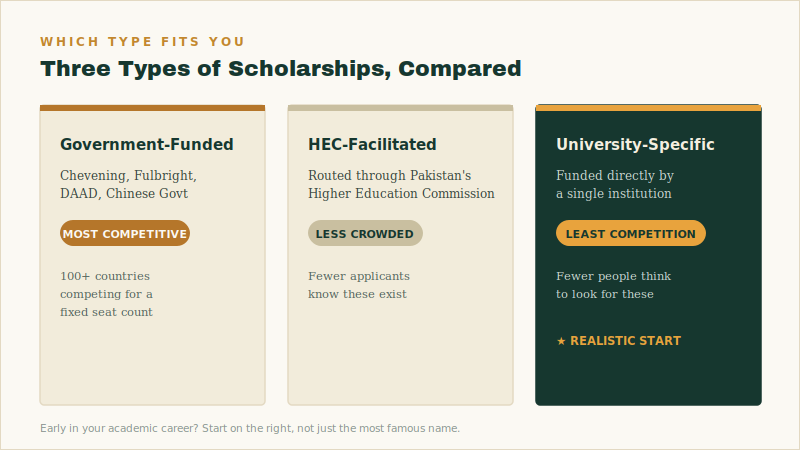
Most lists combine every scholarship together. It is more helpful to consider three categories.
Government-Funded Scholarships
Programs such as Chevening, Fulbright, DAAD, and the Chinese Government Scholarship are funded by another country’s government. These programs are usually competitive because applicants from one hundred or more countries fight for a fixed published number of seats each year.
HEC-Facilitated Scholarships
These go through Pakistan’s Higher Education Commission. Often support fields that the government wishes to invest in, such as STEM and research. Competition can be lower per seat than the biggest global names, simply because fewer applicants know these programs exist.
University-Specific Scholarships
These come directly from an institution instead of a government. They can be worth exploring because university-specific opportunities are often overlooked in broad scholarship searches.
If you are early in your career, HEC-Facilitated Scholarships and University-Specific Scholarships are usually more realistic starting points than the most famous names. That does not mean skip Chevening or Fulbright. The key is to keep your options open rather than relying on a single scholarship pathway.
What Makes a Scholarship Application Stand Out
Every guide lists eligibility criteria. Only a handful explain what actually distinguishes a shortlisted application from one that met the criteria.
Write a Specific Statement of Purpose.
An essay about “always dreaming of studying abroad” reads the same to a reviewer as a hundred other essays that month. What stands out is specificity: one project, one real problem you want to solve, and one clear reason this particular program fits that goal.
Here is the difference in practice. A weak opening line reads something like, “Since childhood I have always been passionate about technology and helping people.” A reviewer has read some version of that sentence hundreds of times. An opening names something specific: “During my final year project I built a low-cost water quality sensor for a village, with no lab access, and it changed what I want to research next.” One sentence proves you did something. The other only claims a feeling.
Help Your Recommenders Write a Stronger Letter
Give your recommender your CV, your specific goals, and two or three concrete points you would like mentioned well before the deadline. A letter written in ten rushed minutes reads like what it is no matter how senior the person signing it is.
Prepare for the Interview Beyond Memorized Answers
Interviewers sit through dozens of these conversations. They notice within a minute whether you are expressing your genuine thoughts or reciting something memorized.
A few questions come up in every scholarship interview in some form. Why this specific? Why did you choose this one over other options? Why this field of study? What problem are you trying to solve with it? Why should this committee choose you over another applicant?
You do not need a polished answer to each one. You need a specific answer you can defend in conversation, not just recite.
Common Mistakes and Scam Warning Signs
A few patterns repeat constantly. Watch for these:
- Applying to only the most famous scholarships. Popular scholarships receive many applications, so lesser-known and university-specific scholarships may be worth exploring too.
- Submitting the same SOP to every program is a common mistake. A reviewer can tell within a paragraph when an essay was not written for their specific program.
- Waiting until a few weeks before the deadline. Strong applications, especially recommendation letters, need real lead time.
- Avoid paying anyone for a “guaranteed” scholarship. Every fully funded scholarship in this guide is free to apply for. If someone asks for money to secure your spot, it is not real.
How to Spot a Scholarship Scam
Every legitimate government or university scholarship is completely free to apply for. If anyone asks for money to “secure”, “process”, or “guarantee” your spot, that scholarship’s not real no matter how official the email or website looks. Close it. Move on.
What to Do If You’re Not Selected
Most applicants to competitive scholarships do not get selected. That is simply the arithmetic of low acceptance numbers and large applicant pools, not a reflection of your worth or your ability.
You can almost always reapply. Many successful applicants were rejected once, revised their SOP with real feedback, and were selected the following cycle. Programs generally do not penalize a previous unsuccessful application. A rejection is information about that specific application, not a verdict on you.
A scholarship is also not the only route to a strong future. If studying abroad does not work out this cycle, paths like in-demand digital skills or freelancing can build real income and real experience while you prepare a stronger application for next time, rather than leaving that year feeling wasted.
Frequently Asked Questions
Are funded scholarships really free to apply for?
Yes. Genuine government and university scholarships do not ask for an application fee. If someone wants you to pay money to get a scholarship, think twice. Check the program on its official website.
Can I apply for a scholarship without IELTS?
Yes, there are scholarship programs that require some proof of English. For example, you may be able to provide a certificate that your previous studies were in English, or you can provide a TOEFL score or IELTS. Always look at the scholarship’s language needs instead of thinking IELTS is always needed.
When Is the Right Time to Start a Scholarship Application?
Start six to nine months before the deadline. Best. This gives you time to collect recommendation letters, write and improve your statement of purpose, and make sure all parts of your application are complete and well done.
Can I apply again after being rejected?
Yes. A rejection does not stop you from applying. Many people apply more than once after making their profile, essays, or overall application. Most programs do not punish students just because they had an application before.
Do I need a CGPA to get a scholarship?
Not always. A high CGPA can help your application. It is not the only thing that matters. In addition, experience, good references, and a well-written application can be very important.
Is It Worth Applying for Several Scholarships?
Yes, applying for scholarships can be a good idea as long as each application is made specifically for the program. Three prepared applications are better than ten applications, with the same copied and pasted essay.
Final Thoughts
The scholarships themselves are not the hard part. Anyone can find a list of a hundred programs in five minutes.
What really makes the difference between an application and a rejected one is preparation. It’s about writing a statement that is both specific and honest. It’s about getting recommendation letters that are meaningful, not just generic. It’s about having enough time to do all of it well.
Start with one program that genuinely fits your field, not the most famous name on the list. Give it the months of preparation it deserves.