
“No experience” is the phrase that stops most students before they even open a blank document. It shouldn’t. You have more real material than you think, and most resume advice never tells you how to use it properly.
This guide walks through building one, piece by piece, using what you actually have. If you are also still unsure what direction to build towards in the first place, our complete guide to choosing the right career path is worth reading before this one.
Why “No Experience” Is the Way to Think About Your Career
Nobody has zero experience. What most students actually have is experience that does not look like a job title yet: coursework, a class project, months of freelancing, a club they ran and a skill they taught themselves on YouTube. None of that appears if you only look at a section labelled “Employment”.
Employers increasingly agree with this shift. According to NACE’s Job Outlook 2026 survey, 70% of employers now use skill-based hiring for entry-level roles, meaning they screen for demonstrated ability over a polished job history. A resume built around real, specific things you did fits exactly what a growing share of employers are already looking for, whether or not you have ever held a formal job.
The goal is not to hide the gap. The goal is to stop viewing it as a gap altogether.
How to Format Your Resume So ATS Software Can Read It
“A person is rarely the first one to actually look at your resume. Most companies run it through screening software first.”
Here’s what that means for you: keep it simple. One column. Normal headings like “Education” and “Experience.” No tables, no text boxes, no fancy graphics—the software skips right over them, and so does anything written inside them.
“PDF is the safer default here. Only switch formats if the application explicitly asks you to.” And when the job post uses a specific phrase, use that exact phrase on your resume. If they say “project management,” do not write “managed projects.” Hope the software will make the connection. It may not.
That’s really it. Simple, readable, no surprises. The software gets through it fine, and so does the tired recruiter reading it right after.
Building Your Resume, Section by Section
Header and Summary
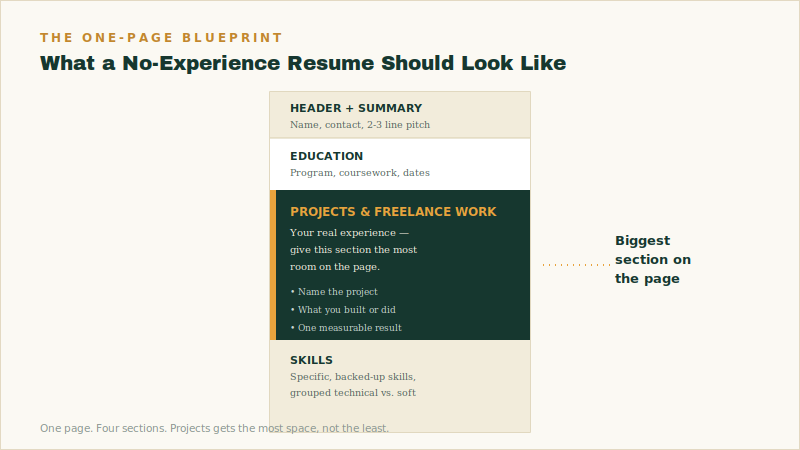
For your contact section, include your full name, phone number, professional email, and location. You do not need to add unnecessary personal details. Skip the old-style “objective” that describes what you want. Instead, write two or three lines that show what you can actually do. Keep it clear and specific enough for a recruiter to understand your strengths without having to read between the lines.
A weak summary says, “student seeking an opportunity to grow and learn.” That doesn’t say much. A stronger one reads: “Marketing student who has run media for two student organizations and freelanced on three small content projects looking to bring that hands-on experience to an entry-level “social media role.”” It gives the recruiter a quick sense of the experience behind the application.
Education, Done Right
List your school, your degree or program, and your expected graduation date. Under that, add coursework. Only include your GPA if it’s strong and the job posting asks for it. This section matters most when you don’t have work history yet. Don’t make it one line. Give it space. Make it count.
Projects and Freelance Work: Your Real Experience
Give this section the attention it deserves. It is where you can turn your skills into clear evidence of what you can actually do.
A class project, a freelance job, a website you built for a business, and a social media account you grew from zero—these all belong here. Treat them like jobs.
See the difference specificity makes. A weak entry says, “Did freelance design work for clients.” That’s vague. A reviewer skims past that in two seconds, because it says nothing they can picture. A stronger entry reads, “Designed logo and social media templates for a bakery delivered across three revisions; the client rehired me for a second project within a month.” The second version proves the work happened and that it went well.
Name the project. Explain what you built or did in language. Add one result if you can—like a follower count that increased or a deadline you always met. If your work is available online, add a link so the recruiter can see it for themselves. A link says more than any word ever could.
Skills
List skills you can actually prove in an interview. Group technical skills separately from softer ones like communication or project management and keep the list specific rather than generic. “Excel” is better than “computer skills.” “Basic Python and SQL” is better than “programming.” Be honest. Be accurate.
Common Mistakes That Get No-Experience Resumes Rejected
A recruiter looks at your resume for a few seconds. These mistakes make them stop reading. Pay attention to them:
- Do not make small work sound as big as real work. A two-week internship is small. Three months of freelance work is big. Give the bigger one more space.
- Do not use words that sound generic. “Hard-working and dedicated” could describe anyone. Use your own simple words instead.
- Do not just describe tasks. Show results. “Posted on social media” is a task. Followers grew by 40% in three months” says what happened. The second one is stronger.
- Do not list basic skills. Everyone can use email in 2026. Remove it. Keep only skills that are rare.
Frequently Asked Questions
Does freelance work really count as experience?
Yes. Whether it’s paid or unpaid freelance work that resulted in something like a website, a design, or an article, it is a valid experience. It should be included in your experience or projects section, not kept hidden.
How long should a no-experience resume be?
One page. At this point you haven’t gained real and relevant material to justify a second page. A one-page resume that is organized looks better than a longer one that is full of unnecessary information.
Should I include a photo on my resume?
It depends on where you’re applying. Some areas expect a photo. In the US and similar places it is often not recommended. In some cases it can even be a reason for rejection. If you are not sure, it is best to leave it off.
What if I genuinely have no projects or freelance work yet?
Start something this week, a small project. A single real project that you can talk about honestly is more valuable on a resume than any amount of advice about “transferable skills.”
Do I need a resume for every single job?
Not a different resume. You can change the summary, the order of your skills, and the relevant projects to match each job posting. This helps the reviewer see the fit quickly without having to rewrite the whole document each time.
Should I list high school achievements once I am in university?
Usually not, unless a specific achievement is unusually relevant to the role. Once you have university-level coursework or projects, high school activities typically make room for the more recent, more relevant material.
Where This data Comes From
The skill-based hiring data in this guide comes from NACE’s (National Association of Colleges and Employers) Job Outlook 2026 survey, published at naceweb.org. The ATS-related guidance reflects widely corroborated practice across major recruiting platforms and applicant tracking system vendors, not one single proprietary source.
This guide is not selling a resume builder. It exists to help you build one properly, using what you already have.
Final Thoughts
A resume with no traditional work history is not a weak resume. It is an unfinished one, and most of what it needs is already sitting in your coursework, your side projects, and the freelance work you may have already started.
Build the projects section first. Everything else on the page gets easier to write once that part is honest and specific.
Send it out. The first one is always the hardest to click send on.