
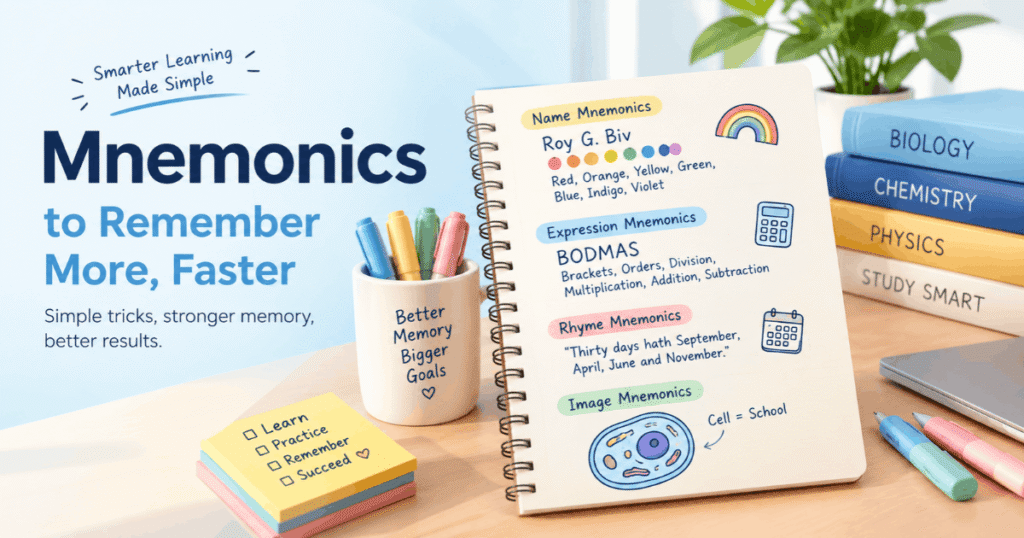
Mnemonic examples for students: learn 9 types of mnemonics with answers for biology, maths, physics and English. Take the quick test and remember more.
It is the night before a test. There is a list in your textbook that will not stay in your mind. Eight planets. Seven ranks of classification. The order of operations. It has been read five times. It still slips away.
Most people simply try to remember things and hope they stick. A mnemonic is an easy way to remember information by connecting it to something familiar, such as a word, picture, rhyme, or song.
Below you will find examples for students in nine types, each with the decoded answer plus a short test at the end. They work whether you are preparing for Matric, FSc, CBSE, O/A Levels, MDCAT or NEET, and you can try most of them tonight. If you are still building a study routine, start with our guide on how to study effectively.
- What Is a Mnemonic?
- 9 Types of Mnemonics With Examples and Answers
- 1. Music Mnemonics
- 2. Name Mnemonics (Letters Become a Name)
- 3. Expression Mnemonics (Funny Sentences)
- 4. Model Mnemonics (Simple Diagrams)
- Rhyme Mnemonics (Short Poems)
- Organising Notes to Remember Better (Neat Notes)
- 7. Image Mnemonics (Silly Pictures)
- 8. Connection Mnemonics (Link to What You Know)
- 9. Spelling Mnemonics (Remember Tricky Words)
- How to Make Your own Mnemonic in 3 Steps
- Do Mnemonics Really Work? What the Research Says
- FAQs; people also asks
- Final Thoughts
What Is a Mnemonic?
A mnemonic (say ‘nih-MON-ik’; the first ‘m’ is silent) is any trick that helps you pull information out of memory. Instead of memorising each item separately, you connect it to something that’s easier to remember. The hook can be a sentence, a picture, a rhyme, a tune or even your own hand.
Searching for ‘mnemonic code’? In programming, a mnemonic is a short word used to represent a machine instruction, such as ADD or MOV. This guide is about memory mnemonics for studying.
9 Types of Mnemonics With Examples and Answers
The nine‑type framework comes from a study‑skills handout by Dennis Congos at the University of Central Florida. The examples below are relevant for students in South Asia. Well-known techniques are also included.
1. Music Mnemonics
Try saying the list along with a familiar song or rhythm. Rhythm gives your memory something to hold on to, which is why music is best for long lists.
Example (classic): the ABC song. Many of us also remembered multiplication tables by chanting them in rhythm.
Answer: The tune helps you remember the 26 letters in the correct order, from A to Z.
2. Name Mnemonics (Letters Become a Name)
Name mnemonics take the first letter of each item and turn them into a name. The best-known example is “Roy G. Biv” is a simple memory trick for learning the rainbow’s colors in the correct order: red, orange, yellow, green, blue, indigo and violet. In many South Asian classrooms, the same colors are taught in reverse as “VIBGYOR”. Use whichever order your teacher follows and say it out loud a few times.
3. Expression Mnemonics (Funny Sentences)
This is the most popular type. You take the first letters of your list and make a word or a funny sentence out of them.
- BODMAS tells you which part of a sum to solve first: Brackets, Orders (powers), Division, Multiplication, Addition, Subtraction. For example, in 5 + 3 × 2, multiplication comes before addition, so the answer is 11, not 16. (In the US the same idea is called PEMDAS.)
- “King Philip Came Over For Good Soup” is a memory trick for remembering the seven taxonomic ranks: Kingdom, Phylum, Class, Order, Family, Genus and Species. If your book starts with Domain, just add “Dear” at the front.
- My Very Educated Mother Just Served Us Noodles gives you the eight planets in order from the Sun: Mercury, Venus, Earth, Mars, Jupiter, Saturn, Uranus and Neptune. Pluto is no longer counted as a planet, so an older sentence ending in “Nine Pizzas” is out of date.
These three are classics that students use in many countries. My own Favorite is a Roman Urdu line that I used for the five kingdoms of life: “Meri Pyari Friend Phir Aayi.” It is a little silly, and that is exactly why it stayed in my head. Take the first letters, M, P, F, P and A, and you get Monera, Protista, Fungi, Plantae and Animalia.
4. Model Mnemonics (Simple Diagrams)
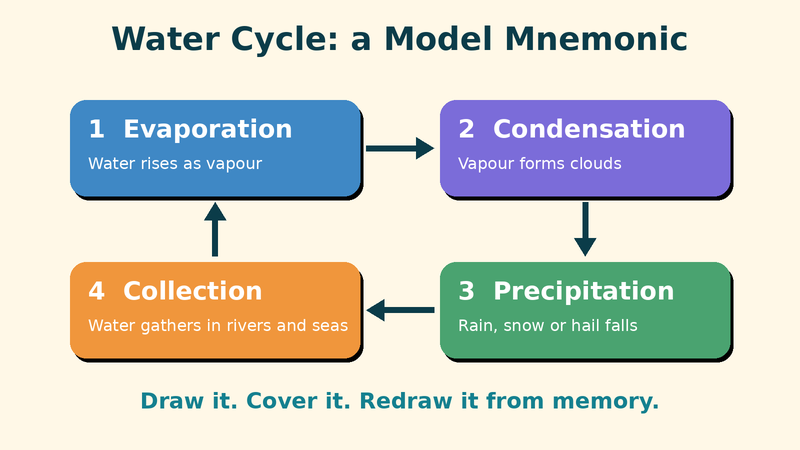
Sometimes a picture on paper works better than words. Draw the water cycle as four boxes in a circle and join them with arrows: evaporation, condensation, precipitation and collection. Then cover the drawing and try to redraw it from memory. Because you can see the shape of the cycle, the order is much easier to recall.
Rhyme Mnemonics (Short Poems)
Rhymes are easy to remember because they have a rhythm. A common example helps students remember how many days are in certain months:
“Thirty days hath September, April, June and November.”
This rhyme reminds you that these four months have 30 days each. The other months have 31 days, except February, which has 28 days in a common year and 29 in a leap year.
Organising Notes to Remember Better (Neat Notes)
Sometimes the way you write your notes is already a memory trick. Short headings, tables, and notecards with a question on one side and the answer on the other make recalling easier, because you can test yourself quickly. Here are the five kingdoms written as a neat list:
- Monera: bacteria
- Protista: amoeba
- Fungi: mushrooms and yeast
- Plantae: plants
- Animalia: animals
Now every kingdom comes with one example that you can picture.
7. Image Mnemonics (Silly Pictures)
Pictures are usually easier to remember than plain lists of words, and the sillier the picture, the better. Imagine a cell as your school. The nucleus is the principal’s office, where all the decisions are made. The mitochondria are the generator room that supplies the whole school with its power. Think of the cell membrane as a school gate. It controls what enters and leaves the cell. When you see “mitochondria” in the exam, you can picture the generator room and remember that it supplies the cell’s energy.
8. Connection Mnemonics (Link to What You Know)
Another trick is to connect something new with something you already know. Lines of latitude run flat, like the rungs of a ladder (lat, ladder), so they go from east to west. Your own hand can help as well. In Fleming’s left-hand rule, your thumb shows the force, your first finger shows the magnetic field and your second finger shows the current.
9. Spelling Mnemonics (Remember Tricky Words)
Spelling mnemonics help you remember words that are difficult to spell.
To remember the difference between “principal” and “principle”, think of your school principal as your pal. This reminds you that “principal” ends in “pal”, while a “principle” is a rule or belief.
How to Make Your own Mnemonic in 3 Steps
- Step 1: Pick the keywords. Choose the words you must remember. For the five kingdoms, that’s Monera, Protista, Fungi, Plantae, and Animalia.
- Step 2: Build a hook in the language you think in. Take the letters (M, P, F, P, A) and make a sentence in English, Urdu, or a mix of both. Make it funny, personal, and a little strange. That’s what sticks.
- Step 3: Say it, then test it. Close the book. Write the list. If you miss a part, alternate the hook. Review it again the next day, then revisit it three days later.
Making your mnemonic takes just a few extra minutes. It’s worth it. Since 1978 psychologists have known that information you create yourself is remembered better than information you just read. That’s the generation effect. It’s not magic. It’s just that the sentence you made up is the one you’re most likely to remember.
Testing yourself is active recall. Close the book, recall the list, and then check. In Roman Urdu: Paro, kitab side par rakho, khud se Jawab do.
Do Mnemonics Really Work? What the Research Says
- Vocabulary. In a 1975 experiment, Richard Atkinson and Michael Raugh taught Russian words using the keyword method. On the most critical test, the keyword group answered 72 percent correctly against 46% for the control group. 1975 study on the keyword mnemonic.
- Long lists. In a 2017 study published in Neuron, Martin Dresler and colleagues trained volunteers with the method of loci for forty sessions of thirty minutes each. Their average recall jumped from twenty‑six to sixty‑two words out of a list of seventy‑two, whereas the two control groups added eleven and seven words. Four months afterward the trained group still remembered about twenty‑two words more than before training.
- The honest limit. A well‑known 2013 review of ten study techniques led by John Dunlosky rated the keyword mnemonic as having utility because its benefits were limited to specific tasks. That review covered the keyword method and text imagery, not every mnemonic. It acts as a reasonable caution. Dresler himself says these methods work for lists and when you use them.
In simple terms, a mnemonic is a key that opens one lock. I think a mnemonic will help you recall names, orders, and terms. You still have to understand the topic. Pair each hook with testing and spaced repetition and the memory will last longer.
A real‑world example is the app Memrise. Memrise is a language-learning app founded by Ed Cooke, a memory expert, and Greg Detre, a neuroscientist. Learners could attach “mems”—user‑made images and phrases—to flashcards, and the app mixed them with testing and spaced reviews. According to the Memrise entry on Wikipedia, mems were removed in September 2022. For students, mnemonics can make information easier to remember, but regular practice and reviewing it over time help you retain it for longer.
FAQs; people also asks
What are the 9 types of mnemonics?
Common types of mnemonics include music, names, words, models, rhymes, organised notes, images, connections, and spelling tricks. Each one is explained with an example above.
What are some popular mnemonic examples?
Common examples include For example, VIBGYOR helps them recall the color’s of a rainbow, while BODMAS reminds them of the correct order of mathematical operations. In biology, “King Philip Came Over For Good Soup” helps students remember the traditional classification system.
What is an example of code?
In programming a mnemonic code is a name for a machine instruction, such as ADD or MOV in assembly language. This idea is based on the mnemonic techniques discussed in this guide.
Do mnemonics really work for exams?
They work well for lists, orders, terms and vocabulary, and studies such as Atkinson and Raugh (1975) and Dresler and colleagues (2017) found gains on those tasks. Mnemonics can help you remember information, but they don’t always help you understand it. A 2013 review suggested that keyword mnemonics may not be very effective on their own. For better results, students can combine them with self-testing and regular revision over time.
Which type of mnemonic is best?
Name-based mnemonics work well for lists, visual mnemonics help you remember terms, and model mnemonics are useful for understanding processes.
How do I make my own mnemonic?
Pick the keywords, build a personal hook from their first letters or a picture, then close the book and test yourself. Repeat after one day, then revisit after three days.
Final Thoughts
Mnemonics won’t do the studying for you. They turn the parts that are pure memory, the lists of orders and names, into something you can recall without a fight, which leaves your energy for the parts that need thinking. For today, select one list from your syllabus, build a hook for it and test yourself tomorrow. AI tools can quickly generate mnemonics, providing a useful starting point for ideas. However, research suggests that you’re more likely to remember a mnemonic over time when you come up with it yourself. To see how these techniques can help with exam preparation, read our guide on how to prepare for exams effectively.