
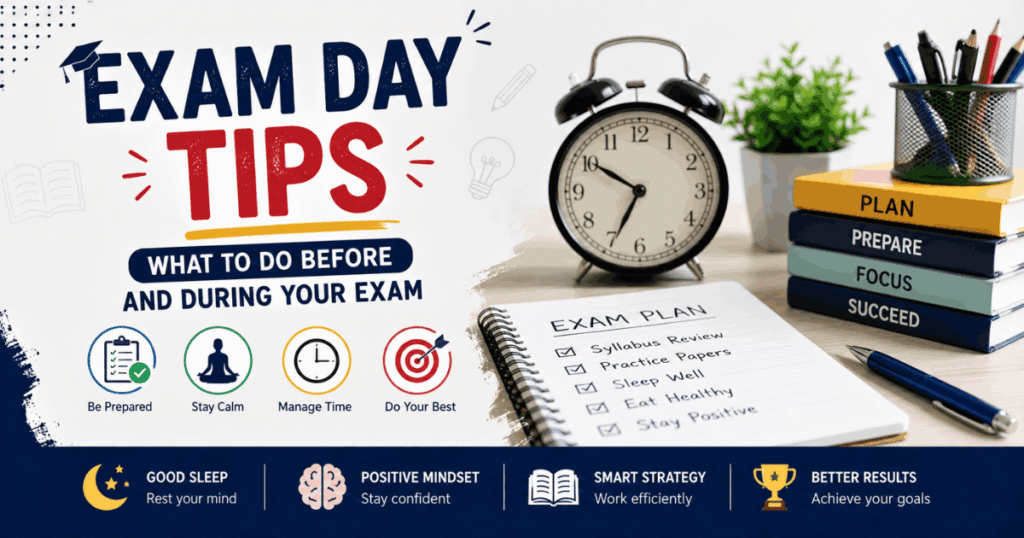
Discover practical exam day tips to stay calm, manage time, avoid common mistakes, and perform your best before and during your exam.
Regardless of the fact that you’ve been studying for weeks , exam day can still feel overwhelming. Many candidates score lower than they should because their nerves took over and they were unable to think through and manage their time effectively.
The good news is that how well you perform on exam day is not dependent only on studying well, if you make the right choices—like getting enough sleep the night before the exam day or making sure you arrive at the exam venue on time.
In this guide you’ll be able to learn useful tips and important pieces of information about how to prepare for different types of exams such as Matriculation exams, Intermediate exams, competitive exams, and university exams.
- The Night Before Your Exam: Set Yourself Up for Success
- Choose Rest Over Last-Minute Cramming
- Start Your Exam Morning the Right Way
- During Your Examination: Be Smart, Not Just Fast
- Don't Let panic to take over your performance.
- Use the Last 10 Minutes Efficiently
- Common Exam Day Mistakes to Avoid
- What to Do After the Exam
- Frequently Asked Questions (FAQs)
- Conclusion;
The Night Before Your Exam: Set Yourself Up for Success
Many students believe the night before an exam day is the best time to study for hours. In reality, this often leads to stress, poor sleep, and mental fatigue the next day. Your goal should be to feel prepared—not exhausted.
Finish Studying Early
Do not try to learn new things the night before your exam. Instead use this time to go over the things you already know like formulas, definitions and key concepts. Just remember all the work you have already done to prepare for your exam.
If there is something you still do not understand do not worry about it. Trying to learn something completely new just a few hours before the exam usually creates more confusion than confidence.
If you’ve been following a well-planned exam revision timetable, avoid trying to learn new topics the night before your exam.
Pack Everything You Need
Preparing your exam essentials the night before the exam day helps you avoid unnecessary stress in the morning.
You will need:
- Admit card or roll number slip
- School, college or university ID (if you need it)
- Two or three pens that work
- Pencils, eraser, sharpener and ruler
- Calculator (only if you are allowed to use it)
- A water bottle you can see through (if you are allowed to have it)
- A watch (if your exam rules say it is okay)
Put all these things in one place so you do not have to look for them when you are leaving your house. While exam day strategies are important, your success also depends on how you prepare for exams effectively in the weeks leading up to the test.
Choose Rest Over Last-Minute Cramming
If the brain is well-rested, the ability to remember information will surpass that of a tired brain. Instead of staying awake until midnight, aim to get 7–8 hours of quality sleep. Getting enough sleep before an exam can improve focus, memory, and concentration.
If you find yourself feeling anxious, try to stay away from social media and from comparing your preparation with your peers. Studying techniques vary from person to person, and discussing things last minute tends to do more harm rather than good.
Before you go to bed remember that you have done your best. A calm mind is one of the best things to have when you walk into the exam hall.
Start Your Exam Morning the Right Way
The way you start your day can set the tone for your day in terms of energy, concentration, and confidence.
Get Up Early
Make sure to wake up early to have enough time to get ready without experiencing any stress or anxiety. Avoid pressing the snooze button too many times if you can. This only works against you in terms of making you more alert in the morning.
Eat a Light, Balanced Breakfast
You should have breakfast. If you do not eat breakfast you will feel tired. You will not be able to focus on your exam. On the other hand if you eat a big meal you will feel sleepy during your exam.
Choose simple foods that provide steady energy, such as:
- Wheat-based toast and eggs.
- Oatmeal.
- Fruits and yogurt.
- Bread and peanut butter.
- Milk or juice.
One should ensure that water intake is sufficient before leaving the house but do not overdo it with sweet water as an excessive sweet intake may lead to energy dips.
Leave Home Earlier Than Necessary
Always consider arriving at the exam venue around 20-30 minutes before the scheduled time. One may experience delays on the road, issues with parking, or other unexpected events during exams.
Arriving early provides one with an opportunity to calm down, check the room number and relax before taking the test.
Before You Enter the Exam Hall: Stay Calm and Focused
The minutes prior to the exam may seem to be stressful, but this isn’t the right time to learn something new. Do not bother about what others have studied; concentrate on keeping calm and confident.
Skip the Last-Minute Cramming
Try not to take notes until the last minute. If you really want to go over your materials quickly, skim through some important points that you have already prepared. Do not compare yourself to your classmates in terms of your preparation; it will only increase your anxiety.
Take a Moment to Relax
Before you walk into the exam hall, make sure you breathe deeply and understand that you are prepared for the examination.
During Your Examination: Be Smart, Not Just Fast
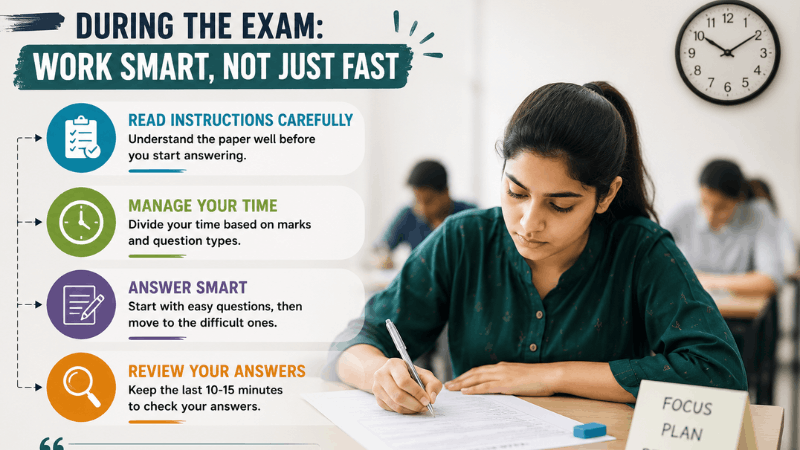
After receiving the questions, do not hurry in starting to answer them. A few extra moments of planning can help you save a lot of trouble later. Once you actually start writing, how you structure each response matters just as much as how you planned for it — our guide on How to Answer Exam Questions Effectively walks through exactly that.”
Read the Instructions Carefully
Start by reading all the instructions on the question paper.
You should pay attention to
- The total number of questions,
- the compulsory and optional questions,
- the number of marks for each question,
- the time allocated for each question, and the special instructions if needed.
Students frequently fail to earn marks just because they answer the wrong number of questions or miss an important instruction.
Scan the Entire Paper First
Use the first few minutes to scan the whole paper. This will give you a good idea of the easy questions, the tough questions, and the time required for each section.
Knowing what to expect goes a long way in helping you stay organised during your exam.
Start with Questions you Already Know
Starting with easy questions gives you confidence in your ability to pass the test.
As you solve the known questions, you’ll ease into it and feel more comfortable, which will allow you to tackle the tougher questions without as much stress.
When you are stuck on a hard question, don’t spend too much time on it. You should go on to other questions and come back to that one later.
Use Your Time Wisely
Good time management makes one of the main differences between good and great papers.
A very effective method is to split time according to the mark a question receives. For the full breakdown of this formula and more minute-by-minute tactics, see our complete guide on How to Manage Time During Exams.
For instance,
- you should spend less time on short questions and more on long-answer ones.
- Keep the final 10–15 minutes for checking your work.
Avoid spending any half the exam of your paper on one difficult question, missing out on all easier questions.
Don’t Let panic to take over your performance.
It is common to face a few challenging questions. Do not judge the rest of the exam based on just one or two difficult questions.
In case you suddenly blank out on a question:
- Stop and pause for a few seconds.
- Breathe deeply.
- Go through the question again slowly.
- Start by answering the question you know.
Always keep in mind that being confident does not mean knowing the answer to every question. Confidence is being in control of your mind, information, and answers.
Use the Last 10 Minutes Efficiently
Usually, students feel relieved as soon as they complete with their writing, but the last few minutes of an exam can be useful in saving several marks. Instead of submitting your paper, utilize the time for checking the answers.
Check the following things before submitting:
- Have you answered all the required questions?
- Have you ensured that the numbers of your questions are correct?
- Have you checked yourself for spelling and any other calculation errors?
- Complete any unfinished answers if time allows
- Lastly, can you ensure that your roll number and other details are filled accurately?
A brief review can let you catch mistakes that will be easy to fix but costly to miss.
Common Exam Day Mistakes to Avoid
Success on exam day isn’t just about doing the right things—it’s also about avoiding common mistakes.
Here’s a list of habits that can affect your performance:
Arriving Late
Reaching the examination center at the last moment only adds to anxiety and makes it harder to settle yourself before the exam starts.
Ignoring the Instructions
A number of students lose points because they don’t read instructions carefully or they answer too few or too many questions than required.
Staying Too Much Time on One Question
If you find one question too difficult, don’t spend your entire exam time on it. Just skip it and return later if necessary.
Panicking About Difficult Questions
There are always rather tricky questions in any exam. Stay cool and focus on what you know, not on what you do not.
Forgetting to Review Your Paper
Submitting your answer sheet without checking it may leave simple mistakes unnoticed.
Want to avoid losing easy marks? Read our guide on common exam mistakes to avoid and learn how to avoid the errors that affect many students during exams.
What to Do After the Exam
After the exam is finished, it’s common to think how you performed. But you should not let yourself spend long hours discussing your answers with friends. This results in unnecessary stress, especially if you have another exam coming soon.
Instead:
- Take short break.
- Have a healthy meal and hydrate yourself.
- Check the schedule for your next exam.
- Concentrate on preparing for the next paper rather than worrying about the one you just completed.
Remember that there is nothing you can do about the exam already taken, but there is always hope for the next one.
Frequently Asked Questions (FAQs)
1. What can I do the night before the exam?
Finish studying early, get all the needed stuff for exam, don’t study late night and sleep for 7–8 hours
2. How can I perform my best on exam day?
On exam day, stay calm, arrive early, eat a healthy breakfast, read the instructions carefully, manage your time wisely, and review your answers before submitting your paper.
3. How much time should I reach the exam hall?
Reach at least 20-30 minutes prior to reporting time so that you can settle down without rushing.
4. What can I do if I don’t know answer to a question?
Keep your cool, move on to the next question if you can’t answer the one you’re stuck with, and return to it later if time allows. Don’t let a tough question affect the rest of your paper.
5. Is it advisable to study till the last minute?
It is fine to go through key points and maintain light revision before the exam but you shouldn’t try to learn any new topic just before the exam.
Conclusion;
The exam day is your chance to show your knowledge—not your ability to cope with pressure. A peaceful mind, solid preparation, and proper time management will provide a significant improvement to your results.
Nobody achieves perfection in an exam, and this can be considered quite natural. You shouldn’t strive for perfection; instead, concentrate on being organised, reading questions attentively, and doing your utmost to answer them.