
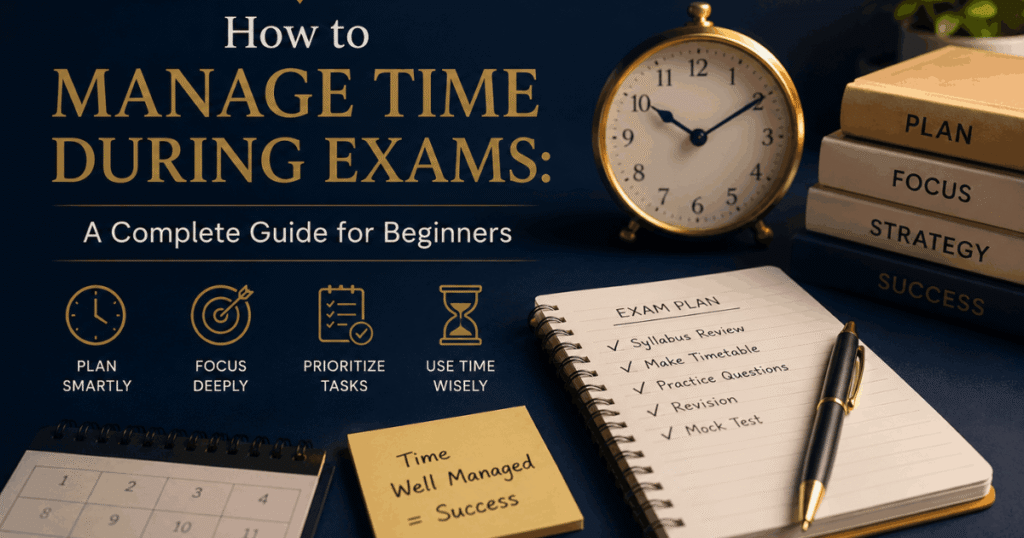
You’ve studied for weeks. You know the material. Then you sit down for the exam, look up at the clock forty minutes in, and realize you’ve barely finished the second question. If that sounds familiar, you’re not alone — a 2024 survey by the learning platform Kahoot! found that nearly half of students name time management as one of their top three academic struggles, ranking above even the difficulty of the material itself.
The good news is that exam time management is a skill, not a talent you’re born with. It can be learned and practiced, even if you’re starting from zero.
This guide walks through exactly how to plan your time before an exam and control it once you’re sitting inside the exam hall, as one more piece of learning to prepare for exams effectively overall.
- Why Time Management Makes or Breaks Your Exam Score
- Prior to the Exam: Plan Your Timing Strategy Early
- The Simple Formula to Divide Your Exam Time
- During the Examination: Minute-by-minute tactics
- What to Do When Time Is Running Low
- Real-World Proof: What a Global Exam Board Shows
- Common Time Management Mistakes to Avoid
- Frequently Asked Questions
- Final Thoughts
Why Time Management Makes or Breaks Your Exam Score
Most students don’t lose marks because they don’t know an answer. They lose marks because they never got to write it down. Spend eighteen minutes on a question worth five marks, and you haven’t just wasted time — you’ve borrowed it from a later question you actually know how to answer. This is the quiet trap inside every exam hall: panic makes you re-read the same paragraph, second-guess an answer you’d already finished, or freeze on one hard question while easier ones sit untouched further down the page. None of this is about intelligence — it’s about pacing, and pacing can be built into a plan long before you walk into the room.
Prior to the Exam: Plan Your Timing Strategy Early
First Learn the Structure of Your Exam Paper
Before the final revision of your test, know its structure: the number of questions, how many marks each is worth, and how much time you will be given. This one information will form the basis of all of your further pacing decisions. If you’re already building a revision timetable for your subjects, allocate fifteen minutes to finding out the format of your exam – you will get a lot more back on the day of your test.
Practice under an Actual Timer, not from the Notes
Studying notes increases your knowledge. Practising under a timer improves your speed. Every week before your test, grab a paper from the past and a visible timer, and do everything as if the real test was taking place: don’t stop, don’t refer to anything. It’s the safest way to learn where you’re slow, without paying anything for it.
The Simple Formula to Divide Your Exam Time
Here’s a formula that removes the guesswork, and it works for almost any exam format:
Time per mark = Total examination time ÷ Total marks available
For example, if your examination takes three hours (180 minutes), and you have 100 marks for it, you get 1.8 minutes per mark. A question worth 10 marks requires around 18 minutes; a question worth 4 marks requires roughly 7 minutes. It is not a hard-and-fast formula, but gives you a starting point for answering questions and leaves you 10 to 15 minutes at the end for a revision and transfer of time between easier and more difficult questions. But having a figure like this in mind when you start answering prevents you from wasting 40 minutes on an examination worth only eight marks – one of the most common reasons students are unable to complete the examination.
During the Examination: Minute-by-minute tactics
Use Reading Time to Plan, Not Just Preview
Before you may begin writing on many examinations, such as Cambridge O-level and A-level papers, you are often given ten to fifteen minutes to read them. Most students only read the questions once and wait throughout this period. Use it better. Using the above technique, make a rough time estimate for each question as you read, and circle the two or three questions you’ll respond to first.
If there isn’t a distinct reading period for your test, spend the first two minutes after you are permitted to write doing the same thing.
Skim First, Answer Easy Questions First
In the first two minutes, before writing anything, quickly skim through the whole examination paper and make a note of which questions can be answered without problems, and which require thinking. Start with the easy. This does two important things.
- First, Not only does it secure your points early on, so that a late start to answering one question won’t ruin the whole result.
- Second, calms you down before the tough part comes. And staying calm in that moment actually starts even earlier, with how you prepare on the morning of the exam.
Stick to Your Per-Question Time Budget
As soon as you work out your time per mark, make a note of the amount of time you aim to spend on each question before you start to work (in most cases, the examination boards accept it). If you reach that time and a question is still unfinished, make a quick choice. Write a short concluding sentence and move on to the next question instead, or mark the spot where you stopped so that you can come back to the question later if you have some time left.
What to Do When Time Is Running Low
You may still have fifteen minutes and two unanswered questions, even with a well-thought-out strategy. Don’t panic. Don’t skip them completely either. Instead of using lengthy paragraphs, use concise, understandable bullet points. Examiners give marks for correct facts, not perfect sentences. More points are awarded for a brief bullet point that demonstrates your understanding of the solution than for a lengthy paragraph that you never complete writing. If you’re not sure what that kind of answer looks like in practice, our guide on how to answer exam questions effectively break it down step by step
Instead of writing one flawless response and leaving another blank, try to respond to every last question, even if it’s only a small one. A few marks on two questions is almost always better than full marks on one question and zero on the other. If you finish early instead, use the extra minutes to check every part of every question. One of the simplest ways to lose points without even realizing it is to miss a tiny portion of a question.
Real-World Proof: What a Global Exam Board Shows
This isn’t just an opinion. For years, actual test boards have observed the same trend. Cambridge Assessment International Education is one of the world’s largest exam boards and the organization behind O Level and A Level exams in Pakistan and more than 170 other countries.
Cambridge publishes official reports after every exam session. They provide students straightforward advice: the best way to learn how to manage time during a paper is to practice previous assignments with a real timer. Reading about a technique is not the same as practicing it with a real clock. This advice is important since it is not exclusive to any one topic or nation. The same concept applies to every test with a time constraint.
Common Time Management Mistakes to Avoid
Even well-prepared students fall into these small traps without noticing:
- Starting with the hardest question first, just to “get it over with”
- Writing a long introduction before actually answering the question
- Forgetting to save time for a final review at the end
- Skipping a small part of a question without checking it
These are just a few examples. For the complete list, read our guide on common exam preparation mistakes students should avoid.
Frequently Asked Questions
Why is time management important in exams?
Because knowing the material and showing what you know under a time limit are two different skills. Poor time management means you can lose marks on questions you actually know the answer to, simply because you never got the chance to write it down.
If I run out of time during a test, what should I do?
Instead of writing lengthy paragraphs, use brief bullet points, and try at least a bit on each of the remaining questions. Everywhere, partial responses are preferable to one flawless response and a blank page.
Is it possible to enhance my test time management skills without a structured study plan?
Indeed. The single most successful habit is timed practice on previous exams. It teaches your brain what it’s like to write an exam for a minute.
What should I do first when the exam starts?
Skim the whole paper before writing anything. Note the easy questions, then answer those first to build confidence and bank early marks.
Q: How can I avoid rushing through my answers?
Stick to your per-question budget instead of racing through everything. A calm, planned pace beats panic.
Final Thoughts
ExamTime management is not a natural ability. It’s more like practicing a routine. The test hall ceases to feel random after you understand the format of the paper, have a basic formula for allocating your time, and have actually practiced it under real, timed settings. Exams are ever-changing. With shorter segments and more stringent digital timers, more of them are going online.
Students who treat pacing as a skill worth practicing, instead of a worry for exam day, are the ones who keep adapting easily. This week, begin with only one timed previous paper. Before the actual exam, you’ll already know more about your personal pace than the majority of students do.