
Imagine two students answer the exact same exam question. Both know the topic well. Both write for roughly the same amount of time. One gets full marks. The other receives barely half. What’s the difference between them? Almost always, it comes down to how they answered, not what they knew. Answering exam questions well is a separate skill from knowing the material.
It comes down to a few learnable habits: reading the question properly, laying out your points clearly, and knowing exactly what an examiner is looking for. Together, they’re the missing piece next to learning to prepare for exams effectively.
- Why Knowing the Answer Isn't Enough
- Understand the Command Word First
- Let the Marks Tell You How Much to Write
- Structure Your Answer So the Examiner Can Follow It
- Turn the Question Into Your First Sentence
- Show Your Method, Not Just the Final Answer
- Different Rules Apply to Multiple-Choice Questions
- Answer-Writing Mistakes That Quietly Cost Marks
- Frequently Asked Questions
- Conclusion (Practice the Skill, Not Just the Subject)
Why Knowing the Answer Isn’t Enough
Here’s what really happens in an exam room. You have read a question. You’re familiar with the topic. You begin writing all you know about it. However, the question did not ask for all you knew. It asked for one particular item, and if your response does not provide the examiner with that one thing, you will lose marks, even if every phrase you wrote is correct. This is distinct from not studying enough. Creating a revision timetable can help you memorize the content properly, but it cannot teach you how to answer questions under test conditions. That is a different talent, and it’s the one this guide focuses on.
Understand the Command Word First
Every exam question has a command word. It is usually a verb such as describe, explain, analyse, or evaluate. This word tells you what the examiner wants you to do in your answer.
Many students overlook these words. As a result, they may write correct information but still lose marks because their answer does not fully match the question.
“Describe” vs. Explain”: Two Words Students Mix Up
Students frequently confuse “describe” and “explain,” which are two of the most prevalent command phrases.
- “Describe” means to describe something’s appearance. It’s just the facts.
- Explain means: say why something happens. Give the reason.
Here’s an example. A question requires you to describe a shadow. An excellent response: “A shadow is a dark shape on the ground, with the same outline as the object above it.” That’s what it says: simply facts, no reasoning.
Now the question asks you to explain why a shadow arises. A suitable response: “A shadow forms because an object blocks light from reaching the ground.” That’s an explanation including the word “because.”
This is the same topic. Two totally different responses.
Let the Marks Tell You How Much to Write
A two-mark question requires two distinct points, not two paragraphs. A 10-mark inquiry requires significant depth, not just one line. Before you begin writing, check the marks next to the question. That figure almost perfectly reflects the examiner’s expectations. Writing a complete page for a 2-mark question wastes time that could be better spent elsewhere, and it frequently indicates that you’re unsure whether part of your answer is important. Writing three lines for a 10-point question wastes marks that a little longer, more thorough answer may easily gain. As a general guideline, aim for one distinct point per mark and double-check that you haven’t gone too much above or below that.
Structure Your Answer So the Examiner Can Follow It
Start With a Direct Answer. Don’t build up to your point slowly. Start your answer with the actual answer. If the question asks whether a policy was effective, your first sentence should say whether it was effective, in plain terms. Examiners often read hundreds of answers in one sitting. A student who states their point immediately is easier to award marks to than a student whose point is buried in paragraph three.
Start With a Direct Answer
Don’t build up to your point slowly. Start your answer with the actual answer. If the question asks whether a policy was effective, your first sentence should say whether it was effective, in plain terms. Examiners often read hundreds of answers in one sitting. A student who states their point immediately is easier to award marks to than a student whose point is buried in paragraph three.
Support Your Point, Then Return to the Question
After your direct answer, add one piece of evidence: an example, a fact, or a calculation. Then, explain how that evidence supports your answer, in your own words.
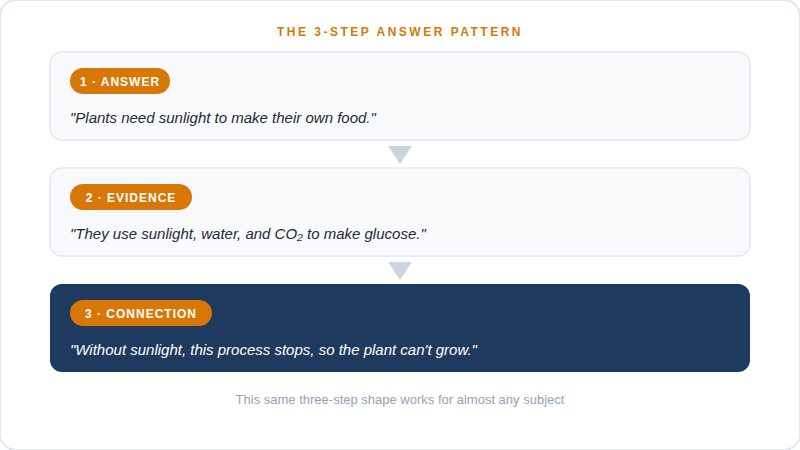
For example, if a question asks why plants need sunlight, you could write: “Plants need sunlight to make their own food.” That’s your answer. Then, provide evidence: “Photosynthesis is the method by which they use sunlight, water, and carbon dioxide to make glucose.” Then bring it home. “Without sunlight, this process stops, so the plant can’t grow.” You can use this three-step pattern—answer, evidence, connection—for almost any topic. It also makes it easier to manage your time during the exam as each answer is following the same short pattern rather than developing into a long, unplanned essay.
Turn the Question Into Your First Sentence
Most students never learn this trick. Instead of starting your answer with a vague sentence, repeat the question’s own words at the very start of your answer.
Here’s how it works. Let’s say the question asks, “Why was the football match cancelled?” A weak opening might sound like, “There are a few reasons for this.” A stronger opening answers the question straight away: “The football match was cancelled because…” Then complete the sentence with the exact reason. This makes your answer clear from the very beginning.
This does two things. First it forces you to answer the same question rather than a slightly different question you assumed was being asked. Second, it shows the examiner immediately that you understood the question even before they read the rest of your answer.
Show Your Method, Not Just the Final Answer
For calculation or structured questions, the final answer is often worth less than you think. Cambridge Assessment International Education, the exam board behind O Level and A Level exams taken across Pakistan and more than 170 other countries, structures many of its mark schemes around separate method and accuracy marks.
A method mark rewards you for showing the correct steps or reasoning, even before you reach a final number.
An accuracy mark, in many cases, can only be awarded once the method mark has already been earned. You can only get marks for getting the right answer if you have already done things the right way. So if you just write down the answer but do not show how you got it, you might lose marks. If you show how you got your answer even if it is wrong, you can still get some marks. Always show your steps, even when you’re confident enough to solve a problem in your head.
Different Rules Apply to Multiple-Choice Questions
Not every question needs a command-word strategy. Different rules apply to multiple-choice questions. Even if the first option seems right, read all the options before selecting one. Exam writers often place a close but wrong answer early on purpose.
If you’re unsure, cross out the options you know are wrong first. This facilitates seeing the actual decision. If you really have no idea what the answer is, just take a guess. Do not leave it blank. A guess always has the potential of earning points, while a blank response never does.
Answer-Writing Mistakes That Quietly Cost Marks
A few habits sneak past students who otherwise know their subject well:
- Restating the question without ever actually answering it
- Ignoring the command word and Writing a list of facts when the question actually asked you to explain why
- Writing everything you know instead of only what’s relevant
- Leaving out your working on a calculation, even when the final answer is correct
These sit alongside a broader list of common exam preparation mistakes students should avoid, worth reading if you want the full picture.
Frequently Asked Questions
How long should my answer be?
Long enough to fully answer the command word and no longer. A short direct answer that hits every required point beats a long one padded with unrelated details.
Should I write in full sentences or bullet points?
Use full sentences for essay and short-answer questions because examiners usually need to see your reasoning. Bullet points work when you’re short, on time and need to show partial understanding quickly.
What is a command word when you are taking an exam?
A command word is the verb that tells you what you need to do, for example describe explain, analyze or evaluate. This command word is really important because it helps you figure out your entire answer, not just the introduction.
What is the difference between the describe and explain?
Describe means you need to give facts about what something’s like. Explain means you need to give reasons and you have to show why or how something happens.
Why do I still lose marks on an exam when I know my answer is correct?
This often happens because you might have answered a question, than the one you were actually asked.. Maybe you left out your working, which is important to show how you got your answer, or gave facts when a judgment was needed. A correct fact isn’t always a complete answer.
Conclusion (Practice the Skill, Not Just the Subject)
Answering exam questions well isn’t about writing more. It’s about writing exactly what the question and its command word are asking for, in a structure the examiner can follow quickly. Learn to spot command words, structure your points clearly, and always show your method. You’ll start closing the gap between what you know and what your exam script actually shows. Try it on just one past paper this week. Pick three questions, identify the command word in each, and answer only that command word. It’s one of the fastest ways to see your marks improve, right alongside the basics like knowing what to do on the morning of your exam.