
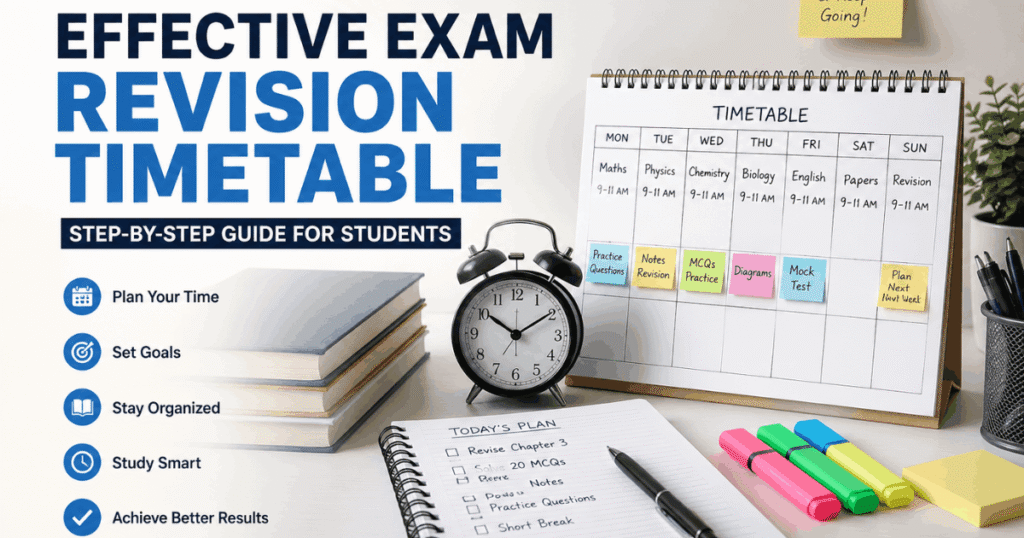
I believe that students undergo a great deal of stress while preparing for exams not because they do not know how to study, but because they do not have a proper plan of action. Many students spend hours studying but still feel unprepared because they don’t know what to study, when to study, or how to manage their time effectively.
The key to solving this problem is the presence of a proper exam revision timetable. If one has a well-prepared timetable, the studying will go smoothly as there will be no confusion about the topics to study. Instead of wasting time trying to figure out what to study, one learns how much time they will need to study each of the subjects, and they will also know the order of revision.
You will be provided with a few tips that will help you make a good revision timetable and avoid the most common mistakes when drawing up your timetable.
- Why Is an Exam Revision Timetable Important?
- Step 1: Check Your Exam Schedule and Available Time
- Step 2: Make a Complete List of Subjects and Topics
- Step 3: Identify Your Strong and Weak Areas
- Step 4: Set Realistic Daily Study Goals
- Step 5: Identify Your Most Effective Study Hours
- Step 6: Generate a Daily Revision Schedule That You Can Actually Stick To
- Step no. 7 – Plan a weekly revision schedule.
- Step 8: Use Proven Revision Techniques
- Step 9: Include Time for Practice and Self-Assessment
- Step 10: Review and Adjust Your Timetable Regularly
- Common Mistakes to avoid
- Frequently Asked Questions
- Final Thoughts
Why Is an Exam Revision Timetable Important?
An exam revision timetable is a structured study plan that helps you organize subjects, manage your time, and revise consistently before exams. It ensures every topic receives enough attention without overwhelming your schedule.
Many students mistakenly assume that the key to good exam preparation is simply studying for long hours. However, spending longer studying does not always imply effective learning.
Without a workable plan, students tend to stick to the easiest topics, procrastinate on difficult subjects, and cram the important chapters only on the last days before the exam. This will only increase stress and make your revision more difficult.
Thus, having a revision timetable enables you to organize your preparation. When you have a revision timetable, you are able to:
- Split your study material into easy parts.
- Plan sufficient time for every subject.
- Identify your weak points well in advance.
- Note your daily and weekly progress.
- Manage your study time together with breaks.
The biggest advantage of a timetable is that it removes decision fatigue. To make your revision sessions more productive, combine your timetable witheffective study strategies recommended by the University of Oxford.
Before creating a revision timetable, it’s important to understand how to prepare for exams effectively so you can build a strong study plan from the start.
Step 1: Check Your Exam Schedule and Available Time
Before you make a plan for studying you need to know how time you really have. This will help you figure out which subjects you should focus on first.
After noting your exam dates, calculate the number of days available for preparation.
Ask yourself some questions.
- How many weeks are left before my exam?
- How many subjects do I need to study?
- Which subjects do I need to practice more?
- How many hours can I really study each day?
Step 2: Make a Complete List of Subjects and Topics
A lot of students make a mistake when they make a study plan without knowing what they need to cover. Before you plan out your study sessions make a list of all your subjects. Then break each subject down into topics or chapters.
For example do not just write “Study Biology”.
Instead write:
- Revise Chapter 1 notes
- Practice important diagrams
- Review mistakes
Breaking down big subjects into smaller tasks makes it easier to see what you need to do.
Step 3: Identify Your Strong and Weak Areas
Before creating your revision timetable, take an honest look at your current preparation. Some topics may only require a quick review, while others need extra practice and attention. Think about the subjects you find most challenging, the topics you often forget, and the chapters where you usually lose marks. These are the areas that should receive more time in your timetable.
At the same time, continue revising your stronger subjects occasionally to keep the information fresh. A balanced revision plan focuses on improving weak areas without neglecting your strengths.
Step 4: Set Realistic Daily Study Goals
Your study schedule only works if it is realistic. A lot of students make plans that are hard to follow and that can be very stressful.
It is better to break down your work into tasks that you can really do instead of trying to finish a whole subject in one day.
For example you can plan to finish one chapter do some practice questions and look at formulas. If you have goals that’re possible to achieve your schedule will be more practical and you will feel motivated, during your exam preparation.
Step 5: Identify Your Most Effective Study Hours
Every student has their peak time during the day. Your timetable needs to be in accordance with your biological clock.
Use your peak time to tackle difficult subjects or problems. For instance:
- Morning – study the hardest subjects or solve problems
- Afternoon – do the easy things, like doing practice tests and exercises
- Evening – review notes and memorize information
Step 6: Generate a Daily Revision Schedule That You Can Actually Stick To
When you know your subject, your available time, and your priorities, the next step is to put your plan into a daily revision schedule.
| Time | Activity |
|---|---|
| 8:00 AM – 9:30 AM | Revise difficult subject |
| 9:30 AM – 9:45 AM | Short break |
| 10:00 AM – 11:00 AM | Practice questions |
| 4:00 PM – 5:30 PM | Study another subject |
| 5:30 PM – 6:00 PM | Break and refresh |
| 7:00 PM – 8:00 PM | Review notes and revise previous topics |
A better approach is to create a balanced schedule with focused study sessions, short breaks, and enough time for revision.
Step no. 7 – Plan a weekly revision schedule.
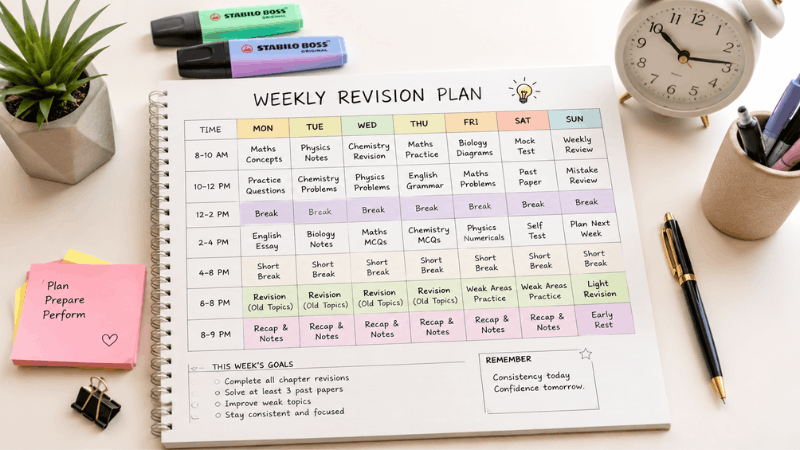
Along with your daily routine, create a simple weekly plan to make sure every subject gets enough attention. Review your progress at the end of each week and adjust your timetable if needed to stay on track.
Step 8: Use Proven Revision Techniques
A revising timetable proves effective when it is supplemented with the right study techniques. The special techniques boost concentration, enhance memories, and make every studying process more effective.
Active Recall
Test yourself instead of re-reading notes to enhance your comprehension and long-term retention.
Spaced Repetition
Review the material after several intervals to retain information better.
Pomodoro Method
Study in focused blocks of time with short breaks to stay focused on learning and not to burnout.
Step 9: Include Time for Practice and Self-Assessment
A great number of students dedicate their time reading books but do not practice enough.
Therefore, your schedule must allow time for:
- Solving past exams.
- Working on exam questions.
- Going over mistakes.
- Taking practice tests..
Regular practice sessions help students discover examination strategies and improve their time management skills.
If a student practices regularly, he/she is going to be more confident during the exam.
Step 10: Review and Adjust Your Timetable Regularly
You do not have to stick by your revision timetable forever. Your preparation will improve over time, and your priorities may change.
Ask yourself the following questions ?
- Have you done as many topics as you had planned?
- Which area needs more efforts?
- Are you perhaps investing too much energy in one subject?
- Is your current timetable realistic
In case it seems ineffective, adjust it.
Flexibility is much more important than having a perfect timetable.
Common Mistakes to avoid
Here are some common blunders to avoid so that you become successful in your exam preparations.
Not Taking Breaks
Studying for extended periods without taking breaks can lead to decreased efficiency. Make a point to schedule adequate break times to recharge and stay concentrated.
Planning Too Much in One Day
When you try to read too many chapters in one day, it would lead to tension and exhaustion. Assign a reasonable amount of study material so that you can successfully accomplish your task.
Ignoring Revision of Older Topics
If you stick solely to the new material, you are likely to forget the information you had already covered. Make sure to have regular revisions.
Comparing Your Timetable With Others
A study schedule that works for another student may not work for you. Revision timetable must correspond to your rhythm and capabilities as well as to your daily routine.
As you prepare for your exams, remember to avoid the common exam mistakes to avoid so your hard work leads to better results.
Frequently Asked Questions
What is the optimal duration of study for exams?
There is no optimal duration of study. Concentrate on a steady study schedule and studious atmosphere that is appropriate for you and your exam objectives.
How far in advance should I write my schedule for revising?
Prepare your revision plan ahead of time to ensure you’re fully ready when it comes to revising.
Would it be more efficient for me to study one subject in a day or several of them?”
Studying one or two subjects in a day is a more effective option than limiting yourself to just one topic, as it allows for more insight and less boredom.
What to do if I don’t manage to stick to my timetable?
If you missed your study deadline, modify your study plan, prioritize vital points, and go on with your plan instead of trying to do everything in one day.
Final Thoughts
An effective exam revision timetable is not about creating the busiest schedule possible. it should be realistic and useful in achieving one’s study goals. The best schedule is the one that considers your goals, available time, and the subjects one feels insecure about studying.
It is important to remember that students who succeed aren’t necessarily one who studies the longest hours. More often than not, successful students are people who know how to manage time wisely and stick to their plan. Your preparation doesn’t end with revision. Learn what to do on exam day to avoid common mistakes and approach your exam with confidence.
Start small. Be consistent, and let your timetable do its job.