

Learn how goal setting for students improves focus, motivation, and academic success. Follow 9 proven steps to set and achieve your study goals effectively.
Did you ever ask yourself, “This time I will study more,” and end up losing your enthusiasm a couple of days later after making this promise? You are not alone.
Countless students want to get good grades, be organized and meet their deadlines, yet they struggle with accomplishing their goals.
Their inability to achieve their goals is not related to lack of intelligence or willpower. The problem lies in the absence of proper guidance while master the process of setting goals.
By setting goals, you clearly know what to study. Instead of being lost in your studies, you’ll have the clarity needed to identify what should be done and what deadlines should be applied.
In this article, you will learn how to create SMART study goals, need to avoid mistakes, and how to create a system that will allow you to move forward all the time.
- What Is the Process of Goal Setting for Students?
- Why Students Struggle to Achieve Their Goals
- Benefits of Goal Setting for Students
- 9 Step Goal-Setting Framework for Students
- Step 4 –Write Your Goals to Paper
- Step 5 – Focus on the Most Important Tasks
- The GOAL Framework: A Simple System That Works
- Mistakes to Avoid When Setting Goals
- Tips to Stay Consistent With Your Goals
- People also ask
- Final Thought
What Is the Process of Goal Setting for Students?
Goal setting is the process of identifying what you want to achieve academically and creating a clear plan to reach that outcome.
Instead of wishing for success, you set concrete targets and work toward them every day.
Let’s examine the two sentences:
❌ “I want to improve my academic performance in the sciences.”
✅ My goal is to finish two science chapters and complete one exercise before Sunday.
The second objective is far more successful, as it provides you a precise target and a deadline. .
In other words:
A dream explains where to go, while a goal explains how to reach it.
When students are aware of their objectives, their focus increases as well as their success level.
Why Students Struggle to Achieve Their Goals
Most students do not fail because they are not motivated. They fail because their goals are not clear.
Think about the difference between saying, “I will study harder “ and “I will finish one Biology chapter before Friday.” The second goal tells students what to do and when to do it.
When students set unclear goals, it is easy for them to procrastinate. Clear goals remove that uncertainty because they tell them what to do, when to do it and how to know if they are making progress.
That is why students who achieve their goals do not just rely on being motivated. They make a plan and stick to it.
If procrastination keeps delaying your goals, check out our guide on How to Stop Procrastination While Studying for practical tips to build consistent study habits.
Benefits of Goal Setting for Students
Goal setting positively impacts academic performance. It provides a clear path for learning and helps you manage your academic journey.
Here are some of the key benefits:
Greater Concentration
With a clear goal, you spend less time deciding what to learn and more time actually learning.
Enhanced Motivation
Goals help you reach your targets and keep you motivated throughout the semester.
Less Procrastination
Big assignments can seem hard to do. When students break them down into smaller goals they are more likely to start working on them. Goal setting for students helps them take action and stop putting things off.
Easier Management of Time
When students have goals they can decide what is important and what is not. This helps them do their work on time of waiting until the last minute. .
Gaining Confidence
When you achieve your goal, you realize you can accomplish something. These small successes gradually build your confidence and inspire you to aim higher.
Setting clear goals is just the beginning. To turn those goals into daily results, explore our guide on How to Be More Productive as a Student for practical strategies to stay focused and organized.
9 Step Goal-Setting Framework for Students
Do not just rely on feeling motivated. Try this practical framework.
Step 1: Know What You Really Want
You need to ask yourself some questions.
- Why i am studying?
- What do i want to achieve this semester?
- Which subject needs the improvement?
When you know what you want it is easier to keep going even when motivation fades.
Step 2: Split Major Goals into Smaller Milestones
Don’t attempt to do everything in one go. Concentrate on one small milestone at a time.
A goal such as “I want to improve my academic performance” may sound inspiring, but it is not aimed. This is why many students fail soon after they begin working toward their target.
What should you do is to break your goal into smaller and realistic tasks.
For example:
- ❌ Get good grades in every subject.
- ✅ Finish one chapter every two days.
Completing small milestones generates success.
Step 3 – Use the SMART Goal Method
Once you’ve broken your goal into smaller milestones, make sure each one is SMART. This simple method turns a vague idea into a clear plan.
A SMART goal is:
| SMART Element | Meaning | Student Example |
|---|---|---|
| Specific | Clear and focused | Complete Chapter 4 Biology |
| Measurable | Easy to track | Solve 50 MCQs |
| Achievable | Realistic | Study 1 hour daily |
| Relevant | Connected to your purpose | Prepare for upcoming exam |
| Time-bound | Has a deadline | Finish by Friday |
Step 4 –Write Your Goals to Paper
A goal is easier to forget when it’s only in your mind.
To make your goal feel substantial, it’s best to write it down and make it stick in your mind. This will also help you focus on things that matter most, instead of other meaningless tasks.
You can write down your goals in:
- A student planner
- A notebook
- Sticky notes
- An application for goal tracking
Write your goals in a place you look at every day. That simple reminder can make a big difference.
Step 5 – Focus on the Most Important Tasks
Not all tasks try to take the same amount of your time. if you do not know where to start with your list of things to do, you should consider this question:
“What task will matter the most in my studying today?” You should do the most important task first and then continue with the others.
A simple way to organize your work is:
- “High Priority” – tasks you need to deal with today.
- “Medium Priority” – importance of tasks that can be postponed.
- “Low Priority” – tasks of no urgency.
Step 6 – Create an Action Plan
A goal indicates what you want to do. In contrast, an action plan explains how you will do it.
After you have formulated your goal, divide it into smaller weekly or daily actions. This helps you view even the toughest goals manageable and gives you a point from which you can start working on them.
Example Action Plan
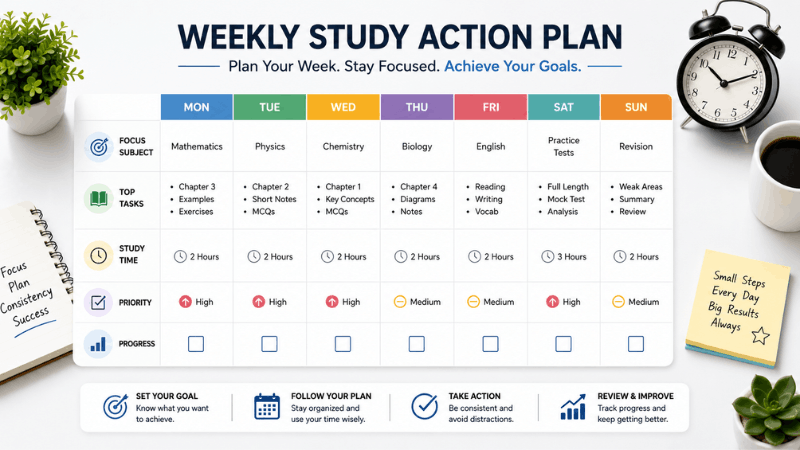
Goal: Score 90% in the mathematics final exam.
| Week | Task |
| Week 1 | Complete Algebra chapters |
| Week 2 | Solve Geometry exercises |
| Week 3 | Practice previous exam papers |
| Week 4 | Revise weak topics and take mock tests |
With a clear plan, you’ll spend less time wondering what to study and more time making real progress. A well-planned schedule makes your goals easier to achieve. Read our Time Management for Students guide to organize your study time more effectively.
Step 7 – Monitor Your Progress
Setting goals is not the end of the story. Monitoring your progress enables you to stay inspired and understand how much you have already accomplished. According to the Harvard University Academic Resource Center, regularly reviewing your progress can help you stay motivated and improve your learning over time.
There’s no need to overcomplicate the process. Just record:
- Daily hours of study
- Mock exams taken
- Weekly targets
- Monthly maps of success
Seeing your progress—even if it’s small—can encourage you to keep going. You can also use the Best Study Apps for Students to organize tasks, track progress, and stay on top of your academic goals.
Step 8 – Stay Flexible
Life doesn’t always goes the way you want it to. You may receive an unexpected assignment, have a terrible week, or just simply a day when studying goes off track.
Rather than not doing anything, make the necessary adjustments and keep working on your agenda.
Keep this slogan in mind:
Changing plans is better than abandoning your goals.
Step 9 – Celebrate Small Wins
Don’t wait until the final exam to celebrate your progress. It’s important to pay attention to each of the smallest accomplishments you achieve as they motivate you.
celebrate your success when you:
- Achieve your homework goals
- Achieve a better score on the test
- Stay consistent for a week.
Celebrating small successes will help you have fun during the process and realize that every little achievement is a step towards reaching your ultimate goal.
The GOAL Framework: A Simple System That Works
SMART goals are useful, but they work best when supported by a clear process. The GOAL Framework gives you that process by breaking goal setting into four practical steps that are easy to follow and apply.
“It’s a practical four-step system that helps you move from intention to action.”
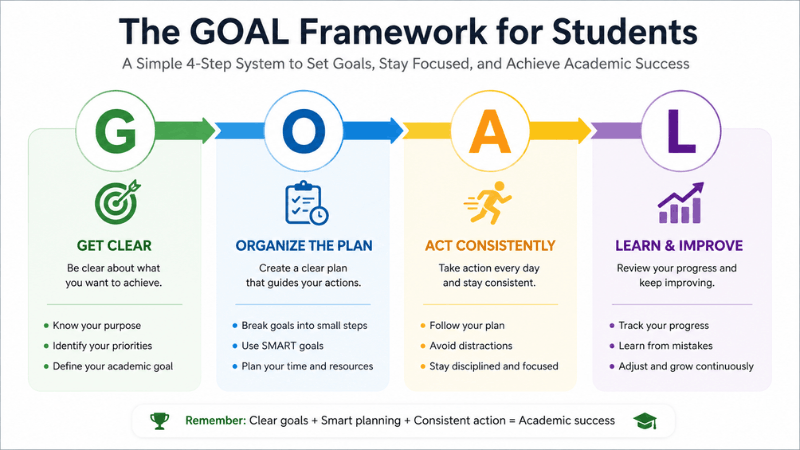
| Step | Meaning | Purpose |
|---|---|---|
| G | Get Clear | Decide exactly what you want to achieve. |
| O | Organize the Plan | Break your goal into smaller tasks. |
| A | Act Consistently | Take small daily actions instead of waiting for motivation. |
| L | Learn and Improve | Review your progress and adjust your plan when needed. |
Mistakes to Avoid When Setting Goals
Goals that are not planned correctly, even if they are good goals, will not work.
Some of the things to avoid are:
- Trying to do too many things at the same time with your goals
- Setting goals that’re not realistic
- Not writing down your goal
- Comparing your goals with the goals of people
- Relying only on motivation to achieve your goals
- Never checking on the performance of your goals
Tips to Stay Consistent With Your Goals
Setting goals is easy. But keeping them every day is challenging.
Here are some habits that will help you:
- Review your goals every morning.
- Study at the time every day to make progress, with your goals
- Eliminate distractions.
- Divide big tasks into smaller parts.
- Learn from the mistakes you make with your goals insteadof giving up on your goals.
If you find it difficult to stay focused for long periods, the Pomodoro Technique for Students can help you study more efficiently with short, productive sessions.
People also ask
What students need to do in order to reach their targets quicker?
In order to achieve objectives faster, students need to develop a clear plan and divide the goal into several parts.
H3: Do SMART goals work for students?
Yes, students are more likely to succeed in their studies when they use SMART goals as they help to clarify what needs to be done.
How often should other students take time to evaluate their goals?
Students should evaluate their achievements every week in order to know what to improve.
Why is goal setting important for students?
It improves focus, motivation, time management, and productivity while helping students stay organized and achieve better academic results.
Final Thought
School success isn’t just about luck or talent. It is built through clear direction and consistent effort.
Setting meaningful goals, breaking them down into smaller steps and tracking your progress all help to make studying less overwhelming and more organised.
Start today with a single small goal. Finish it, get some momentum and keep going. Those little daily accomplishments, over time, will add up to greater academic success.