
Learn how to prepare for exams effectively with proven study techniques, smart planning, revision strategies, and practical tips to improve your exam performance and score higher.
Preparing for exams effectively starts with smart planning, not last-minute cramming. A well-structured study routine helps you understand concepts, retain information longer, and perform with confidence in your exams. Effective studies with a planned approach helps not only to learn the material faster also helps you understand concepts better, retain information longer, and perform with confidence in the exam.
Many students spend hours studying but still struggle to achieve good results because they don’t follow an effective study strategy. However, the good thing is that exam preparation can be learned.
The guide will show you step by step how you can prepare for your exams properly. You will find out how to create a study plan, use appropriate techniques, and practice past exam papers.
- The Key to Successful Exam Preparation
- Step 1: Review Your Syllabus and Prioritize Important Topics
- Step 2: Create a Daily Study and Revision Schedule
- Step 3: Study Smarter with Proven Learning Techniques
- Step 4: Practice with Past Papers and Mock Tests
- Step 5: Use Study Apps and Productivity Tools
- Step 6: Stay Consistent and Avoid Common Mistakes
- Step 7: Review Your Progress and Adjust Your Plan
- Quick Checklist Before Your Exams
- People Also Ask (FAQs)
- Conclusion:
The Key to Successful Exam Preparation
Effective exam preparation is not simply about studying for long hours continuously nor finishing your syllabus at the earliest. It is about striking the right balance through effective study skills, regular revision, adequate practice, and good study habits. When effective study skills combine with timely revision, and regular practice, learning becomes easy and information is retained in memory longer. Instead of rushing through topics at the last minute, a well-planned preparation strategy helps you stay organized, focus on your weak areas, and make steady progress throughout your exam journey.
Now that you understand what effective exam preparation involves, let’s look at the practical steps you can follow to prepare with confidence and achieve better results.
Step 1: Review Your Syllabus and Prioritize Important Topics
Before you start studying make a list of all the things you need to know:
- List all the subjects and chapters you have to study
- Find out which topics are most likely to be on the test based on what was on the test before
- Mark the things you’re not good at so you can work on them more
For example if you are a FSC Biology student you might want to focus on the chapters about genetics, human physiology and ecology because they are usually worth a lot of points.
This way you can make sure you are using your study time for the things that’re most important.
Step 2: Create a Daily Study and Revision Schedule
It is very important to study a bit every day. Here is how you can break up your studying:
- In the morning review the ideas of the new material you are trying to learn
- In the afternoon practice answering questions and solving problems
- In the evening use Flashcards and active recall
Here is an example of what you might do each day for a week:
Sample 7-Day Revision Plan
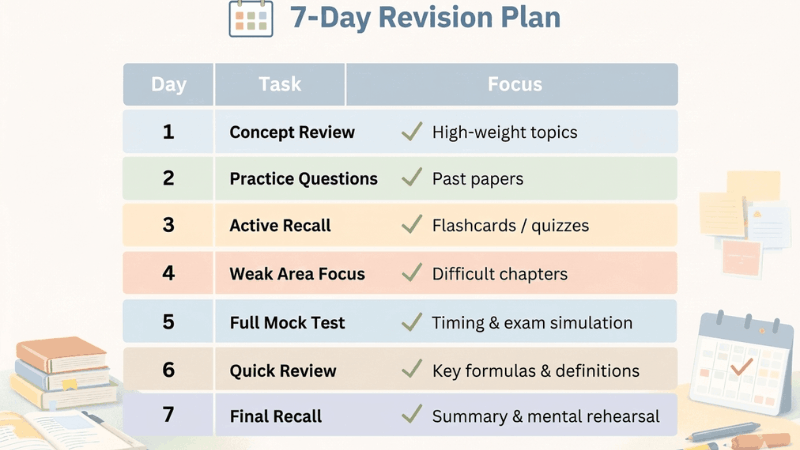
- Review the ideas The most important topics
- Practice answering questions Past tests
- Try to recall the information from memory Flashcards and quizzes
- Work on the things you are not good, at The hardest chapters
- Take a practice test Timing and pretending it is the real test
- Quickly review the main ideas The most important formulas and definitions
- Final review Summary and practicing what you will do on the test
This study plan combines active recall, spaced repetition, and regular practice to help you remember information more effectively and build long-term understanding.
Once you know what to study, the next step is to create an exam revision timetable that helps you organize your subjects and stay on track throughout your exam preparation.
Step 3: Study Smarter with Proven Learning Techniques
The third step requires you to apply study methods which researchers have proven to work.
Active recall
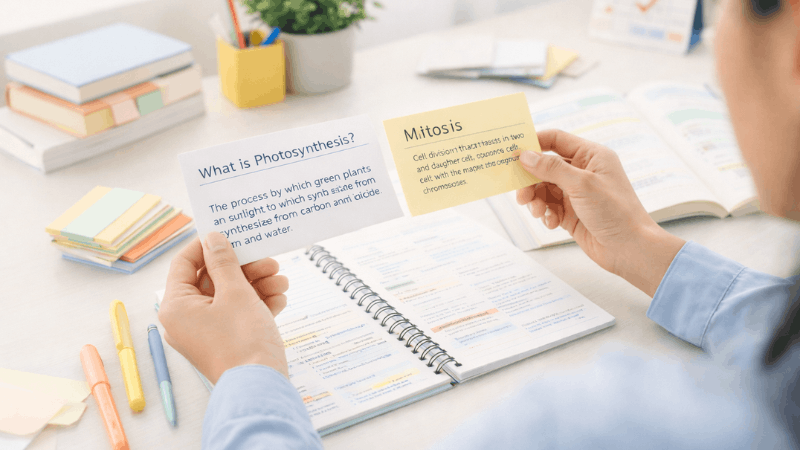
You should test your knowledge through concept assessment instead of rereading your notes. You should write down everything you know about a subject and then compare it to your notes.
Spaced Repetition
Your review of material should occur at progressively longer time intervals. You should review Chapter 1 after one day three days seven days and fourteen days. This method helps to fight against the forgetting curve.
If you want to understand how this method works, read our detailed guide on Spaced Repetition study Method.
Feynman Technique
Teach difficult concepts through basic language which your audience can understand. This method helps people learn better while it reveals their knowledge gaps.
The Feynman technique serves as a study method which students can use to acquire new knowledge.
Step 4: Practice with Past Papers and Mock Tests
The fourth step requires you to use both practice questions and previous examination papers.
Past papers are one of the most valuable preparation resources. They help you understand the exam pattern, improve time management, identify frequently tested topics, and build confidence before the actual exam.
- Students should practice their exam skills through simulation of actual exam conditions.
- Students will learn how to manage their exam time better through testing.
- Students will learn about the most common exam questions through testing.
Example : A student preparing for a competitive exam followed a study plan that include techniques like active recall and spaced repetition, as well as taking practice tests regularly. By reviewing weak topics every week and tracking progress through mock tests, the student became more confident and improved overall performance before the final exam.
In this case, one can see how consistent preparation and proper studying techniques usually give much better results than studying without any plan for a very long time. Past papers are also the best place to practice your answering technique, not just your knowledge. Read our guide on how to answer exam questions effectively to make sure you’re not losing marks on questions you actually know.
Step 5: Use Study Apps and Productivity Tools
The right study tools can make your exam preparation more organized and productive. They help you manage your notes, revise efficiently, and stay focused throughout your preparation. Instead of dealing with everything manually, utilize apps which help you to revise, focus and organize all your study resources.
Anki:
Make flashcards and revise them using spaced repetition algorithm.
Quizlet:
Check your knowledge with the help of flashcards and quizzes.
Evernote:
Keep all your notes, studying plan and revision checklist in one app.
Pomodoro timers:
Study in focused sessions with short breaks between them to maintain your attention.
These apps will not substitute constant work, but they will help you to stay organized and save your time.
Step 6: Stay Consistent and Avoid Common Mistakes
A good study plan only works when you follow it consistently. Instead of relying on last-minute cramming, make steady progress every day and take care of your physical and mental well-being throughout your exam preparation.
Even well-prepared students can lose marks because of avoidable mistakes. Before your exams, take some time to learn about the common exam preparation mistakes that can affect your performance and how to avoid them.
- Focus on one subject or topic at a time instead of multitasking.
- Take breaks from time to time to keep yourself fresh.
- Sleep well, eat properly and drink enough water in order to maintain focus.
- Begin preparing for an exam as early as possible rather than do all the preparations in a couple of days before the exam.
It is easy to avoid these mistakes and become more effective and less stressed while preparing for an exam.
If you struggle to stay focused while studying, improving concentration can significantly enhance your revision sessions. Read our detailed guide on How to Improve Concentration While Studying.
Step 7: Review Your Progress and Adjust Your Plan
Check your progress to ensure that your study plan is effective enough.
- Mark your progress and tick off completed topics.
- Write down your scores when you take quizzes or practice tests.
- Work on those topics and chapters in which you make mistakes very often.
- Update your schedule every time your priorities change.
Tracking your progress helps you stay motivated and ensures that your preparation remains focused on the areas that need the most improvement.
Quick Checklist Before Your Exams
Make sure that you have everything ready before your exams start by following this quick checklist:
- Set up a realistic timetable for revision and stick to it.
- Review important topics using active recall and spaced repetition.
- Attempt some previous year question papers during timed practice.
- Work on your weaker subjects but do not forget about your strong subjects.
- Stay organized regarding your notes, stationery, and other revision material.
- Take proper rest and sleep while revising.
- Hydrate yourself while studying.
- Keep everything ready on the night before the exam day.
Going through this checklist will ensure your organization and preparation for the exams.
People Also Ask (FAQs)
Q1: How hours should I study every day for my exams?
There is no perfect number of study hours for everyone. The best approach is to study in 45–60 minute focused sessions, take regular breaks, and maintain a consistent routine throughout your preparation.
Q2: Should I give the amount of time to all my subjects?
No you should not do that. First you should focus on the subjects that’re very important and the topics that you are not good at. Then you can look at the subjects.
Q3: Can using tools help me study better?
Yes they can. There are apps like Anki and Quizlet that can help you organize your study and remind you to repeat what you studied. This can help you remember things for a time.
Q4: How do I avoid forgetting studied material?
Use spaced repetition and active recall consistently to strengthen long-term memory.
Conclusion:
If you have a plan for studying you can use your study time in a better way feel less stressed and get better grades. For students in Pakistan it is an idea to focus on the most important topics use active learning methods practice with old exam papers and use digital tools. This can help you study in an effective way.
If you want to be successful in the future you should learn how to study smart not study hard. If you start using a study plan from the beginning you will be able to learn things easily and do well in your exams and you will also build a strong foundation, for your future studies.
Once you’ve completed your preparation, don’t forget to follow practical exam day tips to stay calm, learn how to manage your time and perform with confidence on the day of your exam.